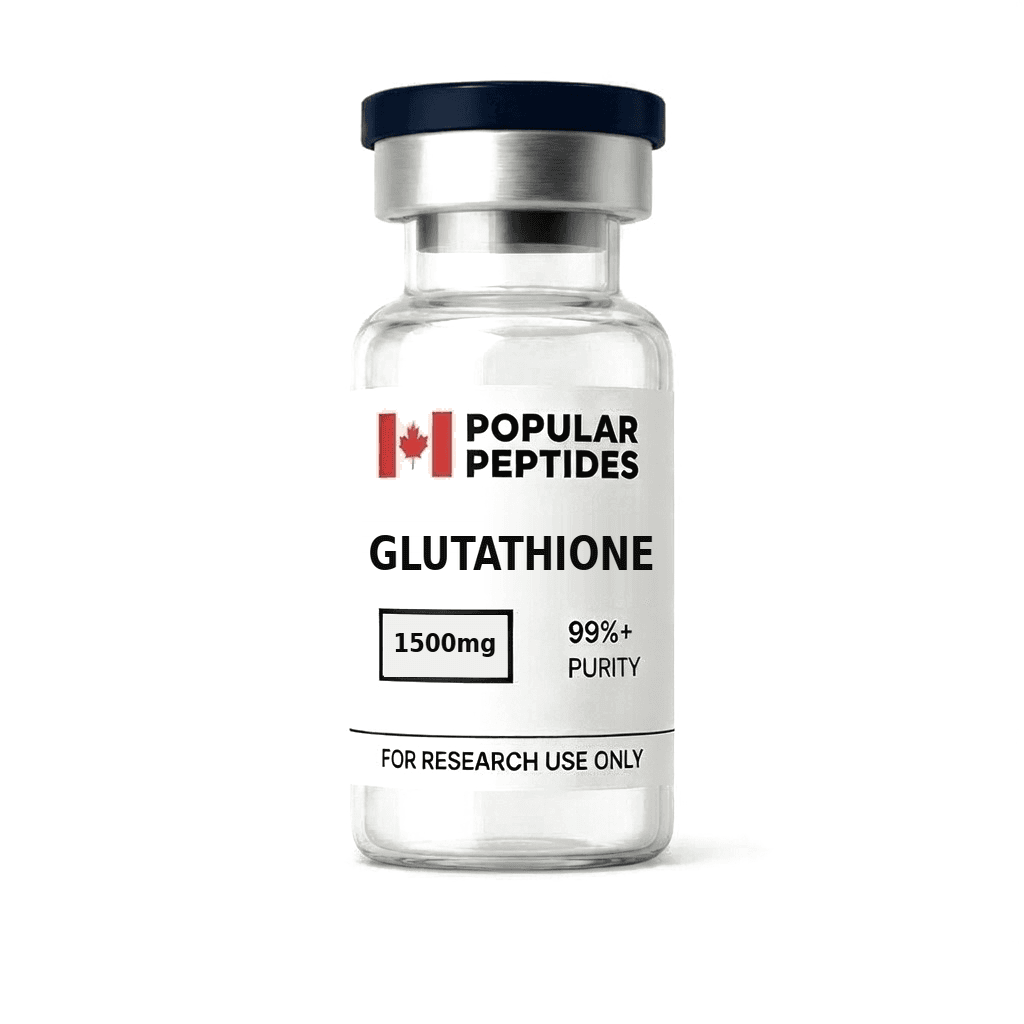
Glutathione1500mg research peptide · Canada
Also written and searched as GSH — same compound, same vial, same lot number.
Reduced glutathione (GSH, γ-Glu-Cys-Gly) tripeptide, freeze-dried, 1500 mg. For lab research only.
Key facts
- Compound:
- Glutathione
- Also known as:
- GSH
- Purity:
- ≥99%, verified by HPLC
- Identity confirmed by:
- LC-MS, independent third-party lab
- CAS number:
- 70-18-8
- Molecular weight:
- 307.3 g/mol
- Certificate of analysis:
- available on request, verifiable by lot number
- Ships from:
- Vancouver, BC — typically 2–5 business days, tracked and insured, no customs
- Intended use:
- in vitro laboratory research only — not for human or veterinary consumption
Page last updated
Glutathione (GSH) is a tiny three-part peptide, made of glutamate, cysteine and glycine, that cells use as their main built-in antioxidant. Its sulfur group soaks up reactive oxygen, which is why it’s one of the most measured molecules in oxidative-stress research. It comes as a freeze-dried powder in a 1500 mg vial.
Glutathione (reduced, GSH) for oxidative-stress and redox research, supplied to Canadian researchers by Popular Peptides. One 1500 mg vial, ≥99% purity, CAS 70-18-8, molecular weight 307.3 g/mol. The batch Certificate of Analysis is available on request. Glutathione was named by Frederick Gowland Hopkins in 1921 and is studied in cell-culture and tissue models of redox balance, detoxification by glutathione S-transferases and the glutathione peroxidase system. Ships tracked and insured from Vancouver by Canada Post Xpresspost, usually 1 to 4 business days, with no customs step and no brokerage fee.
Sold as a laboratory research material only, for in vitro use. It isn’t a medicine and isn’t meant for people or animals.
Research Use Only. This compound is a laboratory material for in vitro research. It is not a medicine and is not for human or veterinary use. If you’re looking for help with your health, please speak with a doctor or pharmacist.
New to research compounds? Start here. Buying in Canada: why domestic means no customs. Checking quality: how to read a COA.
What is Glutathione? Glutathione at a glance
In short: Glutathione is $54.99 CAD at Popular Peptides Canada, ships from Vancouver with no customs, and usually arrives in 1–4 business days.
- What it is
- Glutathione (GSH) is a tiny three-part peptide, made of glutamate, cysteine and glycine, that cells use as their main built-in antioxidant. Its sulfur group soaks up reactive oxygen, which is why it’s one of the most measured molecules in oxidative-stress research.
- Price
- $54.99 CAD. Prices are in Canadian dollars, so there’s no exchange-rate surprise.
- Size
- 1500mg
- Purity
- ≥99%, tested by an independent lab (HPLC for purity, LC-MS for identity)
- Ships from
- Vancouver, BC, to anywhere in Canada. It never crosses a border, so there’s no customs and no brokerage fee.
- Delivery
- Dispatched in 1–2 business days by Canada Post Xpresspost, tracked and insured. Usually 1–2 days in BC, 2–3 on the Prairies and to major Ontario and Québec cities, 2–4 in Atlantic Canada.
- Shipping cost
- Free over $300 CAD, otherwise a flat $20.
- Lab report
- Available on request, and you can look up any batch yourself at popularpeptides.ca/verify.
- Pay with
- Visa, Mastercard, Apple Pay, Google Pay or Interac e-Transfer.
- Sold for
- Laboratory research only. It isn’t a medicine and isn’t meant for people or animals.
New to this? Our plain-language guide explains everything from lab reports to delivery, and our Canada vs imported guide shows why ordering inside Canada is simpler.
Glutathione — compound background
Endogenous thiol tripeptide (γ-L-glutamyl-L-cysteinyl-glycine), reduced form
Glutathione is the tripeptide γ-glutamyl-cysteinyl-glycine. The glutamate is joined through its side-chain (γ) carboxyl rather than the usual α link, which protects it from most peptidases. It was named by Frederick Gowland Hopkins in 1921, and its role in cellular redox chemistry was mapped out through the 20th century, most influentially in Alton Meister's work on the γ-glutamyl cycle.
Solubility & reconstitution
Very water-soluble — far more so than most peptides here — and dissolves in seconds. A fresh aqueous solution is acidic (around pH 3) because of its two carboxyl groups; that low pH actually slows oxidation of the thiol. Raising the pH toward neutral or alkaline, or trace metal ions such as copper and iron, speeds conversion to the disulfide GSSG.
Commonly worked at 50-200 mg/mL for stock solutions.
Storage
Sealed powder is stable at -20 °C long-term; keep desiccated and tightly closed — moisture and air together drive slow oxidation. Refrigerate at 2-8 °C in a full, tightly capped vial to limit headspace oxygen; freeze aliquots for anything beyond a few days.
Commonly worked with for about 1 week at 2-8 °C; frozen aliquots keep longer.
Stability
The one chemistry to protect is the free thiol. Keep solutions cold, slightly acidic and low in oxygen, and use metal-free (or EDTA-containing) buffers where the protocol allows.
Reading the Certificate of Analysis
Check that the main peak is reduced GSH (about 307.3 Da) and look for a GSSG peak (about 612.6 Da) — the GSH:GSSG ratio is the real quality indicator for this compound. Content per vial matters more than usual at a 1500 mg fill.
Background and handling information is educational, for in-vitro laboratory research use only — not medical advice, dosing, or usage guidance, and not a description of use in humans or animals.
How much does Glutathione cost in Canada?+
Where can I buy Glutathione in Canada?+
What sizes of Glutathione are available?+
Is Glutathione third-party tested?+
What purity is Glutathione?+
Is Glutathione intended for human or veterinary use?+
Do you ship Glutathione across Canada?+
How should Glutathione be stored?+
Glutathione laboratory reference
Glutathione is endogenous thiol tripeptide (γ-l-glutamyl-l-cysteinyl-glycine), reduced form. Handling requirements follow from that chemistry rather than from generic peptide guidance — the pages below cover each aspect specifically for this compound.
Lyophilized and reconstituted storage conditions, plus the practical working window.
Diluent selection, dissolution behaviour, and the calculator preset for this compound.
Which solvents work, why, and what abnormal dissolution behaviour indicates.
The specific chemical routes by which this molecule breaks down, and how to limit each.
Which assays are informative for this molecule, and what to actually check on its COA.
Compound-specific bench practices, and the errors most often made with this molecule.
What to inspect on arrival, and which conditions actually warrant rejecting a vial.
Questions specific to this compound — structure, chemistry, and common misconceptions.
Glutathione compared with
Reference content is educational laboratory-handling information for in-vitro research use only — not medical advice, not usage guidance, and not a protocol.