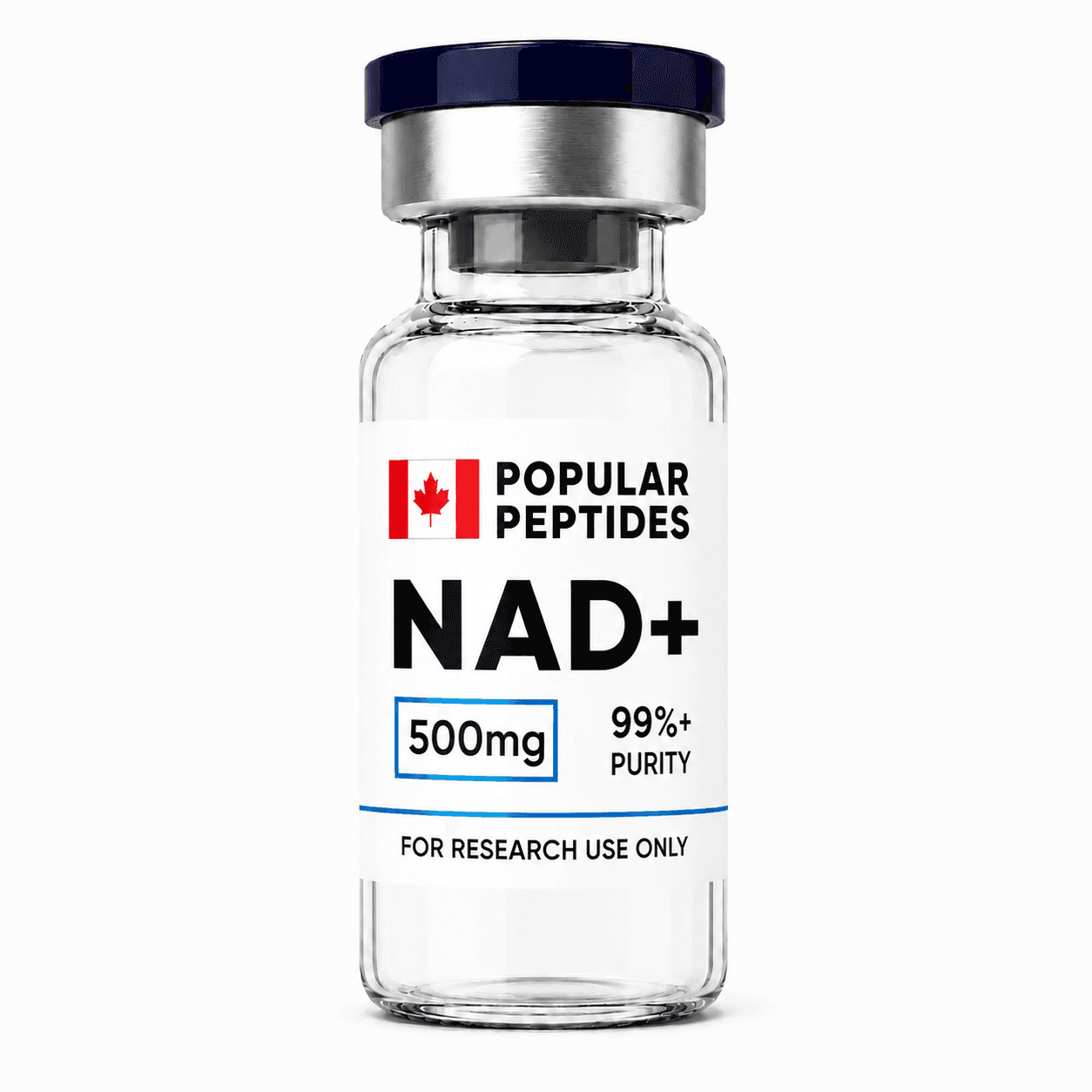
NAD+500mg research peptide · Canada
Buy 2 and save $12.00 — 10% off every unit
- Ships from Vancouver — no customs, no duties
- Dispatched in 1–2 business days · tracked & insured
Add $240.01 more for free shipping
Key facts
- Compound:
- NAD+
- Purity:
- ≥99%, verified by HPLC
- Tested by:
- independent third-party lab (HPLC purity and measured content)
- Molecular weight:
- 663.43 g/mol
- Certificate of analysis:
- available on request · members-only lab results
- Ships from:
- Vancouver, BC — typically 2–5 business days, tracked and insured, no customs
- Intended use:
- in vitro laboratory research only — not for human or veterinary consumption
Page last updated
NAD+ is a molecule found in every living cell. It helps cells turn food into energy, and levels are known to drop with age, which is why it’s so popular in ageing research. This is NAD+ as a freeze-dried powder in a big 500 mg vial. It soaks up moisture easily, so keep the vial sealed and dry.
NAD+ for cellular-longevity research, shipped Canada-wide from Vancouver. One 500 mg vial, ≥99% purity, molecular weight 663.43 g/mol. Tested by an independent lab for purity and content (HPLC), and the lab report (COA) for your batch is available on request. Tracked, insured delivery across Canada — by Canada Post Xpresspost, usually 1 to 4 business days, with no customs step and no brokerage fee.
Sold as a laboratory research material only, for in vitro use. It isn’t a medicine and isn’t meant for people or animals.
Primary literature
- NAD+ metabolism and its roles in cellular processes during ageing — Nature Reviews Molecular Cell Biology, 2021
Covarrubias, Perrone, Grozio & Verdin. The standard reference review on NAD+ decline with age and the enzymes that consume it.
- Chronic nicotinamide riboside supplementation is well-tolerated and elevates NAD+ in healthy middle-aged and older adults — Nature Communications, 2018
Randomised, placebo-controlled crossover trial (n=30). Note this tested oral nicotinamide riboside, an NAD+ precursor, not NAD+ itself.
Cited for research context. A citation is not a claim that this compound is safe, effective, or approved for any use.
Research Use Only. This compound is a laboratory material for in vitro research. It is not a medicine and is not for human or veterinary use. If you’re looking for help with your health, please speak with a doctor or pharmacist.
New to research compounds? Start here. Buying in Canada: why domestic means no customs. Checking quality: how to read a COA.
What is NAD+? NAD+ at a glance
In short: NAD+ is $59.99 CAD at Popular Peptides Canada, ships from Vancouver with no customs, and usually arrives in 1–4 business days.
- What it is
- NAD+ is a molecule found in every living cell. It helps cells turn food into energy, and levels are known to drop with age, which is why it’s so popular in ageing research.
- Price
- $59.99 CAD. Prices are in Canadian dollars, so there’s no exchange-rate surprise.
- Size
- 500mg
- Purity
- ≥99%, tested by an independent lab (HPLC purity and content)
- Ships from
- Vancouver, BC, to anywhere in Canada. It never crosses a border, so there’s no customs and no brokerage fee.
- Delivery
- Dispatched in 1–2 business days by Canada Post Xpresspost, tracked and insured. Usually 1–2 days in BC, 2–3 on the Prairies and to major Ontario and Québec cities, 2–4 in Atlantic Canada.
- Shipping cost
- Free over $300 CAD, otherwise a flat $20.
- Lab report
- Available on request. Lab results are kept in our members-only area.
- Pay with
- Visa, Mastercard, Apple Pay, Google Pay or Interac e-Transfer (an extra 10% off by e-Transfer).
- Sold for
- Laboratory research only. It isn’t a medicine and isn’t meant for people or animals.
New to this? Our plain-language guide explains everything from lab reports to delivery, and our Canada vs imported guide shows why ordering inside Canada is simpler.
NAD+ — compound background
Dinucleotide coenzyme — not a peptide
NAD+ is not a peptide at all, and that single fact governs everything about how it is handled. It is a dinucleotide coenzyme — nicotinamide and adenine linked through a pyrophosphate bridge — present in every living cell and central to redox metabolism. It was first identified in 1906 by Arthur Harden as a small heat-stable factor required for yeast fermentation.
Solubility & reconstitution
Very freely water-soluble — far more so than any peptide here — and the reason vial sizes are measured in hundreds of milligrams rather than single digits. Solutions are clear and faintly yellow at high concentration. Critically, NAD+ is stable in acidic solution and rapidly degraded in alkaline solution, the reverse of the pH preference of many peptides.
Readily exceeds 100 mg/mL; practical limits are set by handling rather than solubility.
Storage
Sealed at -20 °C and rigorously dry. NAD+ is strongly hygroscopic — more so than any peptide in this catalogue — and will draw moisture from room air within minutes of a vial being opened cold. Refrigerate at 2–8 °C and use promptly. Aqueous NAD+ solutions degrade appreciably faster than peptide solutions of comparable storage conditions.
Short: commonly worked with within 1–2 weeks at 2–8 °C, and prepared fresh where accuracy matters.
Stability
Do not apply peptide-handling intuitions to NAD+. It is a nucleotide, its degradation chemistry is hydrolytic rather than oxidative or proteolytic, and its pH sensitivity runs the opposite direction to several peptides in this catalogue.
Reading the Certificate of Analysis
Note the different detection wavelength: nucleotides are read at 260 nm, not the 214 nm used for peptide bonds. Free nicotinamide content is the most informative impurity figure, since it is the direct hydrolysis product. Water content matters more here than for any peptide, given how hygroscopic the material is.
Background and handling information is educational, for in-vitro laboratory research use only — not medical advice, dosing, or usage guidance, and not a description of use in humans or animals.
How much does NAD+ cost in Canada?+
Where can I buy NAD+ in Canada?+
What sizes of NAD+ are available?+
Is NAD+ third-party tested?+
What purity is NAD+?+
Is NAD+ intended for human or veterinary use?+
Do you ship NAD+ across Canada?+
How should NAD+ be stored?+
NAD+ laboratory reference
NAD+ is dinucleotide coenzyme — not a peptide. Handling requirements follow from that chemistry rather than from generic peptide guidance — the pages below cover each aspect specifically for this compound.
Lyophilized and reconstituted storage conditions, plus the practical working window.
Diluent selection, dissolution behaviour, and the calculator preset for this compound.
Which solvents work, why, and what abnormal dissolution behaviour indicates.
The specific chemical routes by which this molecule breaks down, and how to limit each.
Which assays are informative for this molecule, and what to actually check on its COA.
Compound-specific bench practices, and the errors most often made with this molecule.
What to inspect on arrival, and which conditions actually warrant rejecting a vial.
Questions specific to this compound — structure, chemistry, and common misconceptions.
NAD+ compared with
Reference content is educational laboratory-handling information for in-vitro research use only — not medical advice, not usage guidance, and not a protocol.