Glutathione Drips and “Glass Skin”: The Viral Claim, Checked Against the Studies
“Glutathione drips give you glass skin.” Glutathione glow videos are everywhere, and in November 2026 a US telehealth company added glutathione to a new peptide line. Here is what the cell studies, the human trials and the regulators actually say.
The claim
*"Glutathione drips give you glass skin."* The before-and-after videos have been around for years, and the trend got fresh attention in November 2026, when US telehealth company Hims & Hers said glutathione would be part of a new peptide line, alongside NAD+ and sermorelin.
So: does it lighten or brighten skin? Let's check.
What glutathione is
Glutathione (GSH) is a tripeptide: glutamate, cysteine and glycine. Your own cells make it, and it is one of the most abundant small antioxidants inside them. That part is not hype. The question is what extra glutathione does to skin.
What the lab work shows
The skin idea comes from the pigment pathway. A 2005 review in the *International Journal of Cosmetic Science* (Villarama & Maibach) pulled together the proposed mechanisms: glutathione can inactivate tyrosinase, the enzyme that starts melanin production, and it shifts pigment cells from dark eumelanin towards lighter phaeomelanin. In a dish, the mechanism is plausible.
What the human trials show
| Study | Form | People | What it found |
|---|---|---|---|
| Arjinpathana & Asawanonda, *J Dermatolog Treat*, 2012 | Oral | 60 medical students, placebo-controlled | Melanin index fell more than placebo at 2 of 6 skin sites |
| Watanabe et al., *Clin Cosmet Investig Dermatol*, 2014 | Topical (oxidised GSSG) | 30 women, split-face, placebo-controlled | Lower melanin index on the treated side |
| Handog et al., *Int J Dermatol*, 2016 | Lozenge | Small, open-label | Modest lightening |
| Zubair et al., *J Pak Assoc Dermatol*, 2016 | Intravenous | 50 enrolled, 32 finished | 37.5% improved vs 18.7% on placebo, not statistically significant (p = 0.054); side effects in all subjects, one anaphylaxis, abnormal liver tests led to exclusions; the effect faded |
A 2018 review in *Dermatology Practical & Conceptual* (Sonthalia et al.) read the same papers and called the evidence limited: modest, reversible changes by mouth or on the skin, and a single IV trial with design and analysis problems.
So the pattern is the opposite of the viral one. The drip, the form in the videos, has the weakest data.
Regulators
- —United States: the FDA warned consumers in 2019 that no injectable skin-lightening product is approved, and that products sold online or in spas (containing glutathione, vitamin C, collagen and more) carry real risks.
- —Philippines: its FDA warned in July 2019 that injectable glutathione is approved only as an add-on in cisplatin chemotherapy, not for skin lightening, and listed liver, kidney and nerve toxicity, infection risk and Stevens-Johnson syndrome as concerns.
- —Canada: glutathione is not one of the 14 peptides named in Health Canada’s April 2026 advisory on injecting peptides bought online. That is not an approval: the advisory says a “research use only” label does not make a product legal to sell for human use.
Verdict
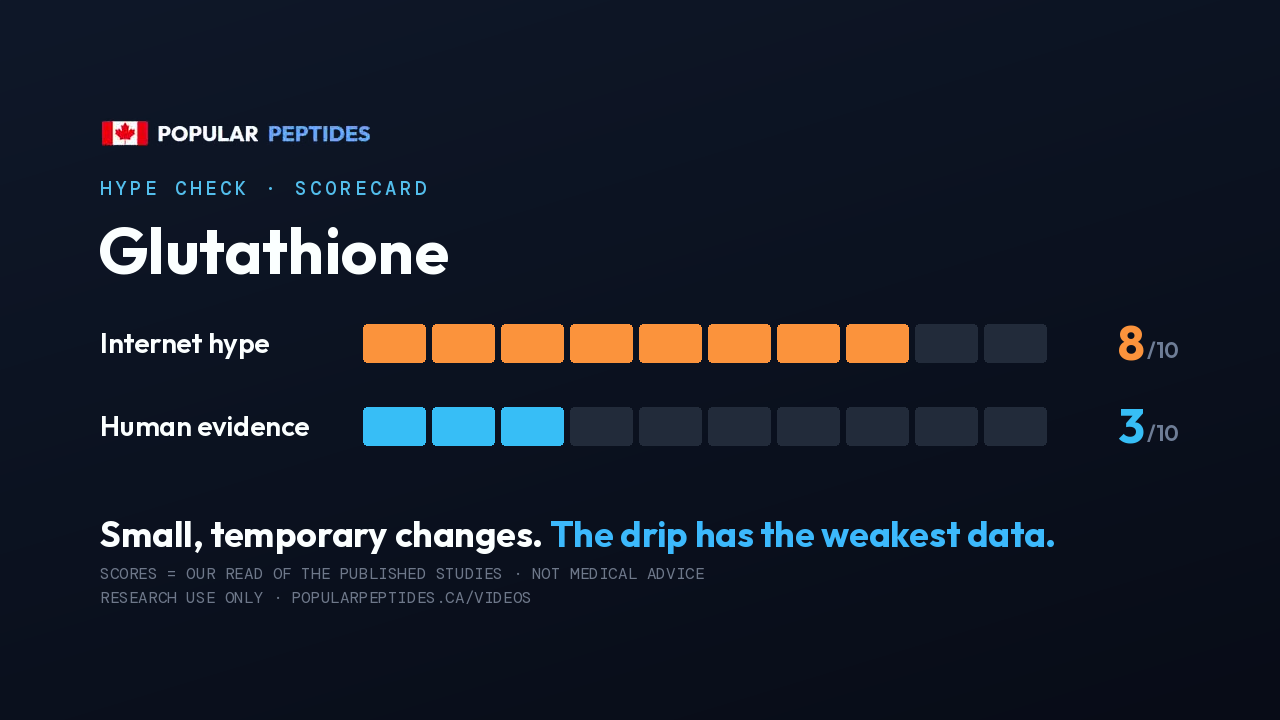
Hype 8/10, human evidence 3/10. Small, temporary changes in small trials, and the drip has the weakest data of all. Read the studies, not the before-and-afters.
FAQ
Do glutathione drips lighten skin?
The only placebo-controlled intravenous trial found no statistically significant difference from placebo, frequent side effects and one case of anaphylaxis, and the effect faded after stopping.
Is there any evidence for glutathione and skin tone?
Some, and it is modest. Small oral, topical and lozenge trials reported reduced melanin measures that reversed after stopping. None were large, long-term trials.
Is injectable glutathione approved for skin whitening?
No injectable skin-lightening product is approved by the US FDA, which warned against them in 2019. The Philippine FDA issued a similar warning the same year.
Is glutathione a peptide?
Yes. It is a tripeptide (γ-Glu-Cys-Gly) with an unusual bond through the glutamate side chain. For the chemistry, see the glutathione research notes.
---
For laboratories: our glutathione is reduced GSH for in vitro redox research, and it is one of the four vials in Researching Beauty?. Popular Peptides supplies research compounds for in vitro laboratory research use only. They are not approved by Health Canada for therapeutic use and are not intended for human or veterinary consumption. 18+. Certificates of Analysis (COAs) are for members only.
For the research material itself: glutathione peptide Canada (1500 mg reduced GSH), how to store glutathione powder and the glutathione reconstitution calculator.
Key takeaways
- Glutathione is a three-amino-acid peptide (γ-Glu-Cys-Gly) that cells make themselves; it is one of the body’s main antioxidants.
- In lab work it can inactivate tyrosinase and shift pigment cells from dark eumelanin towards lighter phaeomelanin (reviewed by Villarama & Maibach, International Journal of Cosmetic Science, 2005).
- Human trials are small: oral (2012), topical (2014) and lozenge (2016) studies reported modest skin-tone changes that faded after stopping.
- The only placebo-controlled intravenous trial (Zubair et al., Journal of Pakistan Association of Dermatologists, 2016) found no statistically significant difference, frequent side effects and one case of anaphylaxis.
- No injectable skin-lightening product is approved by the US FDA, which warned consumers about them in 2019.
We source from distributors whose batches are third-party tested for HPLC purity and measured content. Certificates of Analysis (COAs) are for members only.