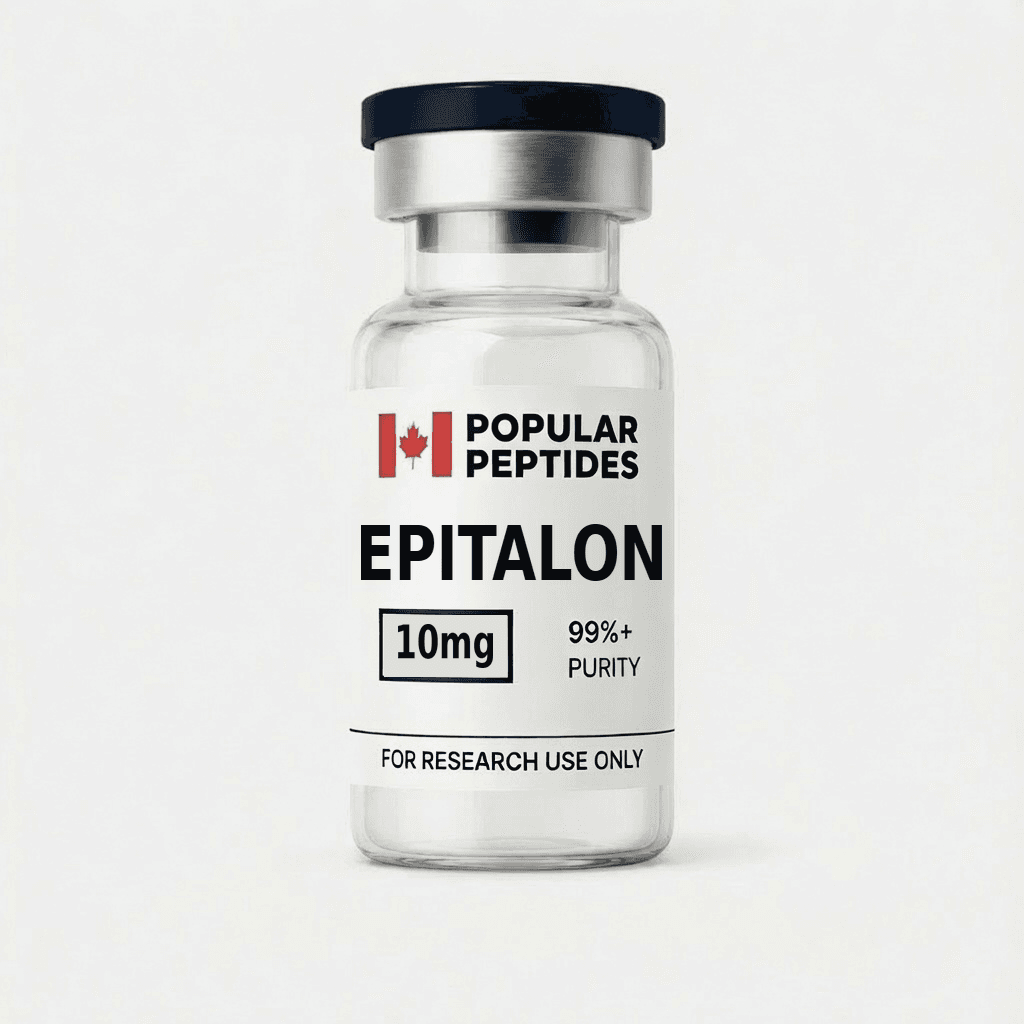
Epithalon10mg research peptide · Canada
Also written and searched as Epitalon — same compound, same vial, same lot number.
Buy 2 and save $7.00 — 10% off every unit
- Ships from Vancouver — no customs, no duties
- Dispatched in 1–2 business days · tracked & insured
Add $265.01 more for free shipping
Key facts
- Compound:
- Epithalon
- Also known as:
- Epitalon
- Purity:
- ≥98%, verified by HPLC
- Tested by:
- independent third-party lab (HPLC purity and measured content)
- CAS number:
- 307297-39-8
- Molecular weight:
- 390.35 g/mol
- Certificate of analysis:
- available on request · members-only lab results
- Ships from:
- Vancouver, BC — typically 2–5 business days, tracked and insured, no customs
- Intended use:
- in vitro laboratory research only — not for human or veterinary consumption
Page last updated
Epithalon (also spelled Epitalon) is a tiny, four-amino-acid peptide based on a natural extract from the pineal gland. It’s popular in ageing research, especially studies on telomeres, the protective caps on the ends of your DNA. It comes as a freeze-dried powder in a 10 mg vial.
Epithalon, supplied to Canadian researchers by Popular Peptides. One 10 mg vial, ≥98% purity, CAS 307297-39-8, molecular weight 390.35 g/mol. Tested by an independent lab for purity and content (HPLC); the lab report (COA) for your batch is available on request. Ships tracked and insured from Vancouver by Canada Post Xpresspost, usually 1 to 4 business days, with no customs step and no brokerage fee.
Sold as a laboratory research material only, for in vitro use. It isn’t a medicine and isn’t meant for people or animals.
Primary literature
- Epithalon Peptide Induces Telomerase Activity and Telomere Elongation in Human Somatic Cells — Bulletin of Experimental Biology and Medicine, 2003
Khavinson et al. In vitro study of telomerase activity and telomere length in human fetal fibroblast cultures.
Cited for research context. A citation is not a claim that this compound is safe, effective, or approved for any use.
Research Use Only. This compound is a laboratory material for in vitro research. It is not a medicine and is not for human or veterinary use. If you’re looking for help with your health, please speak with a doctor or pharmacist.
New to research compounds? Start here. Buying in Canada: why domestic means no customs. Checking quality: how to read a COA.
What is Epithalon? Epithalon at a glance
In short: Epithalon is $34.99 CAD at Popular Peptides Canada, ships from Vancouver with no customs, and usually arrives in 1–4 business days.
- What it is
- Epithalon (also spelled Epitalon) is a tiny, four-amino-acid peptide based on a natural extract from the pineal gland. It’s popular in ageing research, especially studies on telomeres, the protective caps on the ends of your DNA.
- Price
- $34.99 CAD. Prices are in Canadian dollars, so there’s no exchange-rate surprise.
- Size
- 10mg
- Purity
- ≥98%, tested by an independent lab (HPLC purity and content)
- Ships from
- Vancouver, BC, to anywhere in Canada. It never crosses a border, so there’s no customs and no brokerage fee.
- Delivery
- Dispatched in 1–2 business days by Canada Post Xpresspost, tracked and insured. Usually 1–2 days in BC, 2–3 on the Prairies and to major Ontario and Québec cities, 2–4 in Atlantic Canada.
- Shipping cost
- Free over $300 CAD, otherwise a flat $20.
- Lab report
- Available on request. Lab results are kept in our members-only area.
- Pay with
- Visa, Mastercard, Apple Pay, Google Pay or Interac e-Transfer (an extra 10% off by e-Transfer).
- Sold for
- Laboratory research only. It isn’t a medicine and isn’t meant for people or animals.
New to this? Our plain-language guide explains everything from lab reports to delivery, and our Canada vs imported guide shows why ordering inside Canada is simpler.
Epithalon — compound background
Synthetic tetrapeptide (Ala-Glu-Asp-Gly)
Epithalon is a four-residue peptide derived by Vladimir Khavinson's group from Epithalamin, a pineal gland extract studied in the Soviet Union from the 1970s. It represents the reductionist end of the peptide field — the attempt to identify the shortest sequence retaining the activity of a complex tissue extract. At 390 Da it is the smallest compound in this catalogue by a wide margin.
Solubility & reconstitution
Extremely water-soluble and effectively instantaneous to dissolve. With only four residues, two of them acidic, there is no hydrophobic character and no conformational complexity whatsoever. If an Epithalon vial does not clear immediately, the problem is the vial, not the chemistry.
Storage
Sealed at -20 °C; short 2–8 °C periods are entirely acceptable for a molecule this small and simple. Refrigerate at 2–8 °C. No methionine, cysteine, or tryptophan — light protection is not the priority it is for other compounds here.
Commonly worked with for 3–4 weeks at 2–8 °C.
Stability
Epithalon's one genuine chemical liability is the Asp-Gly isomerisation site. Because isomerisation does not change mass, it is invisible to LC-MS and shows only on the chromatogram — the same analytical blind spot that affects DSIP.
Reading the Certificate of Analysis
Confirm the mass at 390.3 Da. Note that very small, very polar peptides are chromatographically difficult — they elute near the void volume on standard RP-HPLC. A COA that shows good separation for a tetrapeptide reflects a properly developed method; one showing a peak crammed at the solvent front does not tell you much.
Background and handling information is educational, for in-vitro laboratory research use only — not medical advice, dosing, or usage guidance, and not a description of use in humans or animals.
How much does Epithalon cost in Canada?+
Where can I buy Epithalon in Canada?+
What sizes of Epithalon are available?+
Is Epithalon third-party tested?+
What purity is Epithalon?+
Is Epithalon intended for human or veterinary use?+
Do you ship Epithalon across Canada?+
How should Epithalon be stored?+
Epithalon laboratory reference
Epithalon is synthetic tetrapeptide (ala-glu-asp-gly). Handling requirements follow from that chemistry rather than from generic peptide guidance — the pages below cover each aspect specifically for this compound.
Lyophilized and reconstituted storage conditions, plus the practical working window.
Diluent selection, dissolution behaviour, and the calculator preset for this compound.
Which solvents work, why, and what abnormal dissolution behaviour indicates.
The specific chemical routes by which this molecule breaks down, and how to limit each.
Which assays are informative for this molecule, and what to actually check on its COA.
Compound-specific bench practices, and the errors most often made with this molecule.
What to inspect on arrival, and which conditions actually warrant rejecting a vial.
Questions specific to this compound — structure, chemistry, and common misconceptions.
Epithalon compared with
Reference content is educational laboratory-handling information for in-vitro research use only — not medical advice, not usage guidance, and not a protocol.