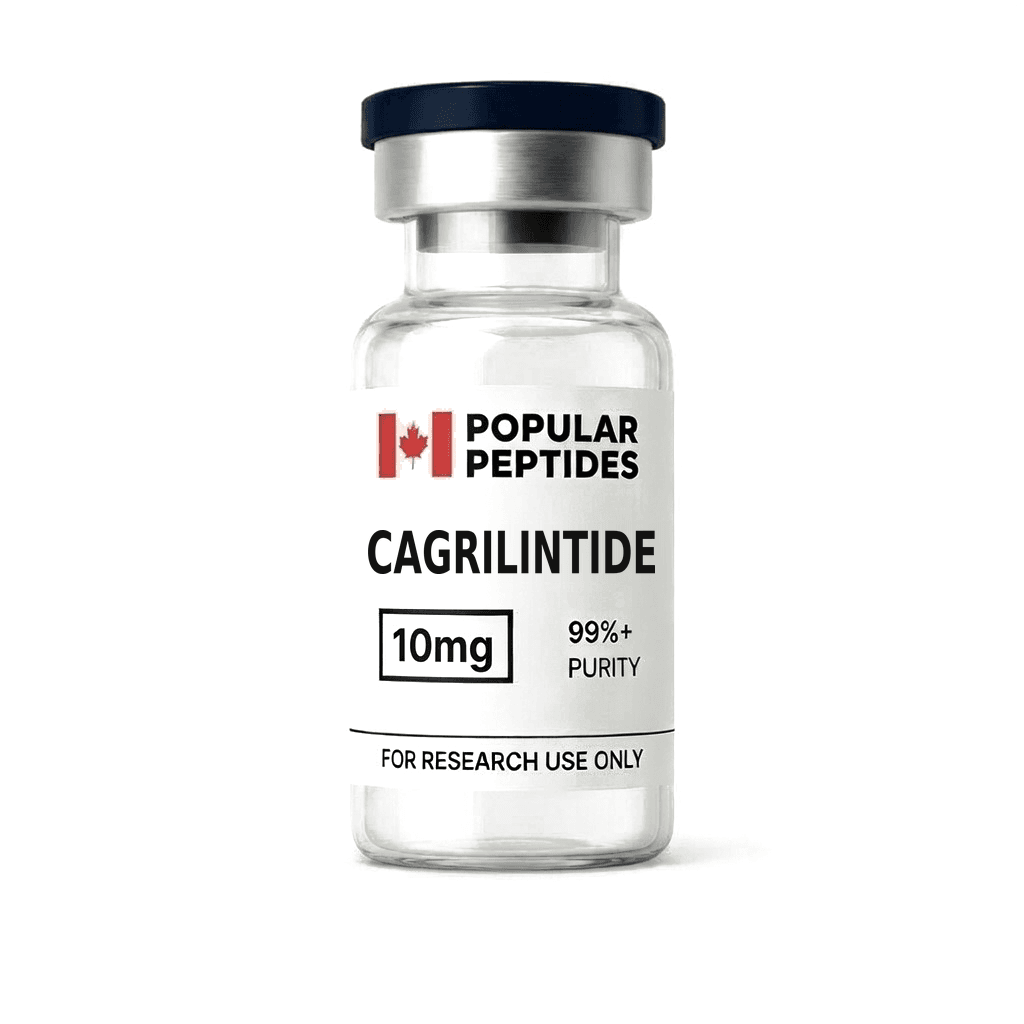
Cagrilintide10mg research peptide · Canada
Buy 2 and save $15.00 — 10% off every unit
- Ships from Vancouver — no customs, no duties
- Dispatched in 1–2 business days · tracked & insured
Add $225.01 more for free shipping
Key facts
- Compound:
- Cagrilintide
- Purity:
- ≥99%, verified by HPLC
- Tested by:
- independent third-party lab (HPLC purity and measured content)
- Certificate of analysis:
- available on request · members-only lab results
- Ships from:
- Vancouver, BC — typically 2–5 business days, tracked and insured, no customs
- Intended use:
- in vitro laboratory research only — not for human or veterinary consumption
Page last updated
Cagrilintide is a long-lasting, lab-made version of amylin, a hormone your body releases alongside insulin. It’s often studied together with GLP-1 compounds, and it’s one half of the combination known as CagriSema. It comes as a freeze-dried powder in a 10 mg vial.
Buy Cagrilintide in Canada direct from Popular Peptides. One 10 mg vial, ≥99% purity. Tested by an independent third-party laboratory — HPLC purity, content assay, and identity by retention time and spectral match — and the lab report (COA) for your batch is available on request. Tracked, insured delivery from Vancouver, BC — by Canada Post Xpresspost, usually 1 to 4 business days, with no customs step and no brokerage fee.
Sold as a laboratory research material only, for in vitro use. It isn’t a medicine and isn’t meant for people or animals.
Primary literature
- Once-weekly cagrilintide for weight management in people with overweight and obesity: a dose-finding phase 2 trial — The Lancet, 2021
The monotherapy dose-finding trial (n=706), 26 weeks, against both placebo and an active comparator.
- Coadministered Cagrilintide and Semaglutide in Adults with Overweight or Obesity — New England Journal of Medicine, 2025
REDEFINE 1 (n=3,417, 68 weeks). Includes a cagrilintide-alone arm alongside the combination.
- Cagrilintide–Semaglutide in Adults with Overweight or Obesity and Type 2 Diabetes — New England Journal of Medicine, 2025
REDEFINE 2 (n=1,206, 68 weeks), the type 2 diabetes population.
Cited for research context. A citation is not a claim that this compound is safe, effective, or approved for any use.
Research Use Only. This compound is a laboratory material for in vitro research. It is not a medicine and is not for human or veterinary use. If you’re looking for help with your health, please speak with a doctor or pharmacist.
New to research compounds? Start here. Buying in Canada: why domestic means no customs. Checking quality: how to read a COA.
What is Cagrilintide? Cagrilintide at a glance
In short: Cagrilintide is $74.99 CAD at Popular Peptides Canada, ships from Vancouver with no customs, and usually arrives in 1–4 business days.
- What it is
- Cagrilintide is a long-lasting, lab-made version of amylin, a hormone your body releases alongside insulin. It’s often studied together with GLP-1 compounds, and it’s one half of the combination known as CagriSema.
- Price
- $74.99 CAD. Prices are in Canadian dollars, so there’s no exchange-rate surprise.
- Size
- 10mg
- Purity
- ≥99%, tested by an independent lab (HPLC purity and content)
- Ships from
- Vancouver, BC, to anywhere in Canada. It never crosses a border, so there’s no customs and no brokerage fee.
- Delivery
- Dispatched in 1–2 business days by Canada Post Xpresspost, tracked and insured. Usually 1–2 days in BC, 2–3 on the Prairies and to major Ontario and Québec cities, 2–4 in Atlantic Canada.
- Shipping cost
- Free over $300 CAD, otherwise a flat $20.
- Lab report
- Available on request. Lab results are kept in our members-only area.
- Pay with
- Visa, Mastercard, Apple Pay, Google Pay or Interac e-Transfer (an extra 10% off by e-Transfer).
- Sold for
- Laboratory research only. It isn’t a medicine and isn’t meant for people or animals.
New to this? Our plain-language guide explains everything from lab reports to delivery, and our Canada vs imported guide shows why ordering inside Canada is simpler.
Cagrilintide — compound background
Lipidated 37-residue amylin analogue, Cys2–Cys7 disulfide, C-terminal prolinamide
Cagrilintide is an engineered analogue of human amylin (IAPP), the 37-residue hormone co-secreted with insulin from pancreatic beta cells. Its design problem was unusually specific: native amylin is strongly amyloidogenic, readily collapsing from helix into the beta-sheet conformation that seeds fibrils, which is what made a long-acting amylin drug difficult for decades. Cagrilintide carries six substitutions relative to human amylin (14E, 17R, 25P, 28P, 29P, 37P) — roughly 84% sequence homology — plus N-terminal acylation with a C20 fatty diacid through a gamma-glutamate linker.
Solubility & reconstitution
Reported aqueous solubility varies widely between reagent suppliers — from sparingly soluble in PBS at pH 7.2 to freely soluble in water with sonication — so treat any single published figure as buffer-, pH- and lot-dependent rather than a fixed property. The behaviour is characteristic of lipidated peptides: the C20 diacid that drives albumin binding also drives self-association, which makes apparent solubility sensitive to conditions. Introduce diluent slowly and allow time before concluding a vial has failed to dissolve.
Commonly worked at 1–5 mg/mL; confirm against the batch COA rather than assuming.
Storage
Sealed at -20 °C, protected from moisture. Supplier data sheets for the reagent-grade material specify sealed storage under nitrogen, away from moisture and light. Refrigerate at 2–8 °C. As with other fatty-acid-acylated peptides, the acylation that extends half-life also contributes real solution stability.
Commonly worked with for 3–4 weeks at 2–8 °C.
Stability
The engineering story is worth knowing because it dictates handling. Two substitutions, N14E and V17R, place oppositely charged residues where they form an intramolecular Glu14–Arg17 salt bridge that stabilises the alpha-helix; the C-terminal prolines break beta-sheet propensity. Physical stability in the discovery work was screened by Thioflavin T fibrillation lag-time assay. The practical consequence is that gentle handling matters more here than for a simple linear peptide.
Reading the Certificate of Analysis
Confirm the mass near 4409 Da. Because the sequence carries a Cys2–Cys7 disulfide, correct disulfide pairing is a meaningful identity question that a purity percentage alone does not answer. As with other acylated peptides, aggregate content by size-exclusion chromatography adds information RP-HPLC cannot, since the organic mobile phase tends to dissociate soluble aggregates before they are detected.
Background and handling information is educational, for in-vitro laboratory research use only — not medical advice, dosing, or usage guidance, and not a description of use in humans or animals.
How much does Cagrilintide cost in Canada?+
Where can I buy Cagrilintide in Canada?+
What sizes of Cagrilintide are available?+
Is Cagrilintide third-party tested?+
What purity is Cagrilintide?+
Is Cagrilintide intended for human or veterinary use?+
Do you ship Cagrilintide across Canada?+
How should Cagrilintide be stored?+
Cagrilintide laboratory reference
Cagrilintide is lipidated 37-residue amylin analogue, cys2–cys7 disulfide, c-terminal prolinamide. Handling requirements follow from that chemistry rather than from generic peptide guidance — the pages below cover each aspect specifically for this compound.
Lyophilized and reconstituted storage conditions, plus the practical working window.
Diluent selection, dissolution behaviour, and the calculator preset for this compound.
Which solvents work, why, and what abnormal dissolution behaviour indicates.
The specific chemical routes by which this molecule breaks down, and how to limit each.
Which assays are informative for this molecule, and what to actually check on its COA.
Compound-specific bench practices, and the errors most often made with this molecule.
What to inspect on arrival, and which conditions actually warrant rejecting a vial.
Questions specific to this compound — structure, chemistry, and common misconceptions.
Cagrilintide compared with
Reference content is educational laboratory-handling information for in-vitro research use only — not medical advice, not usage guidance, and not a protocol.