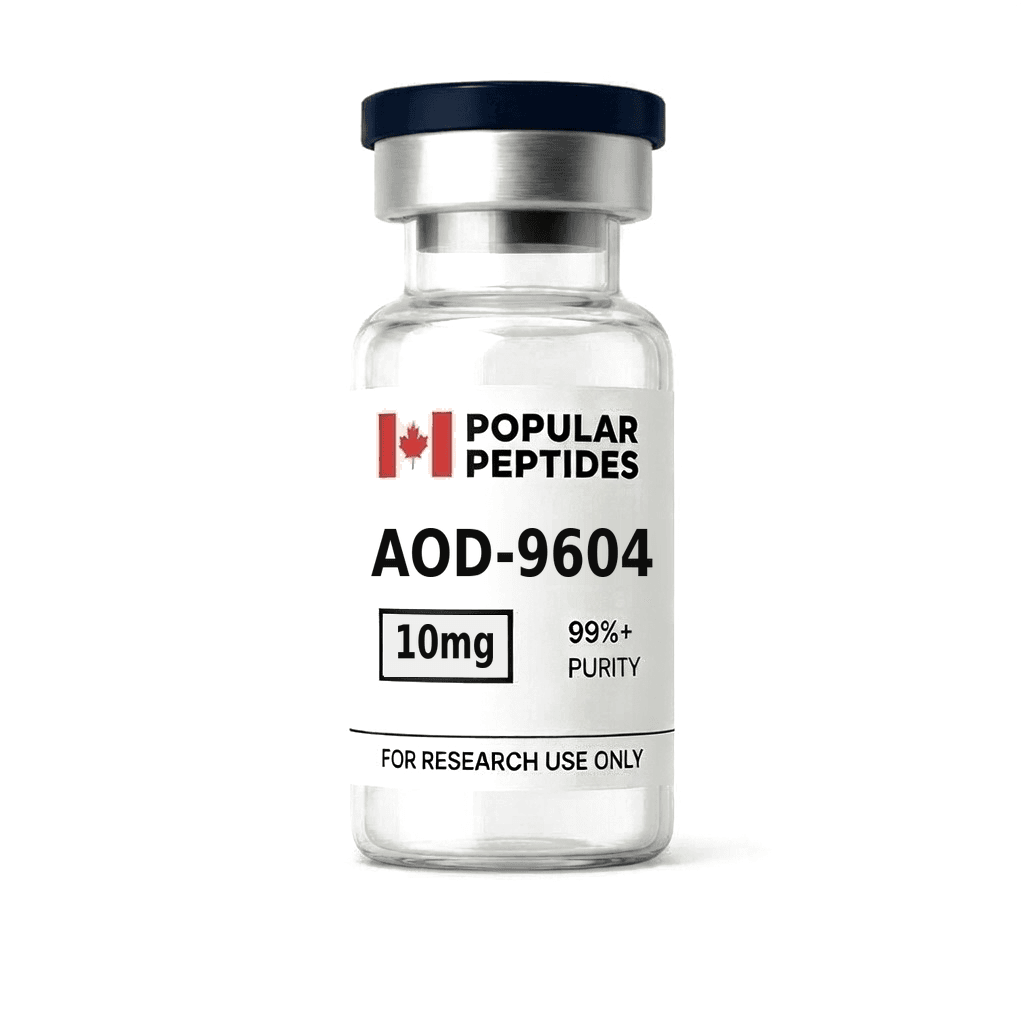
AOD-9604
Also written and searched as AOD9604 — same compound, same vial, same lot number.
hGH C-terminal fragment analogue (Tyr-hGH 177-191, AOD9604), lyophilised. For in vitro research use only.
Key facts
- Compound:
- AOD-9604
- Also known as:
- AOD9604
- Purity:
- ≥99%, verified by HPLC
- Identity confirmed by:
- LC-MS, independent third-party lab
- CAS number:
- 221231-10-3
- Molecular weight:
- 1815.1 g/mol
- Certificate of analysis:
- available on request, verifiable by lot number
- Ships from:
- Vancouver, BC — typically 2–5 business days, tracked and insured, no customs
- Intended use:
- in vitro laboratory research only — not for human or veterinary consumption
Page last updated
AOD-9604 is a synthetic 16-residue peptide corresponding to the C-terminal region of human growth hormone (Tyr-hGH 177-191), with a disulfide bridge between its two cysteines.
AOD-9604 for metabolic and lipid-metabolism research, supplied to Canadian researchers by Popular Peptides. One 10 mg vial, ≥99% purity, CAS 221231-10-3, molecular weight 1815.1 g/mol. The batch Certificate of Analysis is available on request. The peptide was developed in Australia around the lipolytic domain of growth hormone and has been examined in published rodent studies of lipid metabolism. Ships tracked and insured from Vancouver in 2 to 5 business days, with no customs step and no brokerage fee.
Supplied lyophilised for in vitro laboratory research use only; not intended for human or veterinary use.
Primary literature
- The effects of human GH and its lipolytic fragment (AOD9604) on lipid metabolism following chronic treatment in obese mice and beta(3)-AR knock-out mice — Endocrinology, 2001
Heffernan et al., 142(12):5182-5189. Compared hGH and AOD9604 in obese and β3-AR knockout mice; concluded the lipolytic actions were not mediated directly through β3-AR.
- Metabolic studies of a synthetic lipolytic domain (AOD9604) of human growth hormone — Hormone Research, 2000
Ng et al., 53(6):274-278. Obese Zucker rat study; reported no impairment of insulin sensitivity on euglycaemic clamp, unlike intact hGH.
- Safety and Tolerability of the Hexadecapeptide AOD9604 in Humans — Journal of Endocrinology and Metabolism, 2013
Stier et al., 3(1-2):7-15. Safety analysis across six randomised, placebo-controlled trials: no change in serum IGF-1 and no anti-AOD9604 antibodies detected.
- Effect of Intra-articular Injection of AOD9604 with or without Hyaluronic Acid in Rabbit Osteoarthritis Model — Annals of Clinical & Laboratory Science, 2015
Kwon & Park, 45(4):426-432. Collagenase-induced knee osteoarthritis model in rabbits (n=32), scoring cartilage morphology, histology and lameness.
Cited for research context. A citation is not a claim that this compound is safe, effective, or approved for any use.
⚠️ Research Use Only. This compound is intended for in vitro research and laboratory use only. Not for human or veterinary consumption.
AOD-9604 — compound background
16-residue hGH C-terminal fragment analogue with one intramolecular disulfide
AOD-9604 is residues 177-191 of human growth hormone with an extra tyrosine added at the N-terminus (Tyr-Leu-Arg-Ile-Val-Gln-Cys-Arg-Ser-Val-Glu-Gly-Ser-Cys-Gly-Phe), closed by a disulfide between the two cysteines. It came out of Frank Ng's group at Monash University in Australia and was developed by Metabolic Pharmaceuticals in Melbourne as an obesity candidate. That programme was discontinued in 2007 after a 24-week phase 2b trial did not show a clinically meaningful outcome, and the compound never reached approval as a medicine.
Solubility & reconstitution
Water-soluble at ordinary working strengths. Two arginines give it a small net positive charge at neutral pH, which offsets the stretch of hydrophobic residues (Leu, Ile, Val, Phe). Avoid any diluent or buffer containing reducing agents such as DTT, TCEP or β-mercaptoethanol — they open the disulfide that defines the molecule.
Commonly worked at 1-5 mg/mL.
Storage
Sealed powder is stable at -20 °C long-term; keep desiccated. Refrigerate at 2-8 °C and keep near neutral pH; aliquot for anything beyond short-term use.
Commonly worked with for 2-3 weeks at 2-8 °C in bacteriostatic water.
Stability
It carries no methionine or tryptophan, so light and oxygen are minor concerns compared with many peptides here. The chemistry to protect is the disulfide: keep pH near neutral and keep reducing agents out of the vial.
Reading the Certificate of Analysis
Where mass data is given, the oxidised (disulfide-closed) target is about 1815.1 Da average, 1813.86 Da monoisotopic. A peak near 1817 Da indicates the reduced, open-chain form; a species near twice the mass indicates a disulfide-linked dimer. Check peptide content separately from HPLC purity.
Background and handling information is educational, for in-vitro laboratory research use only — not medical advice, dosing, or usage guidance, and not a description of use in humans or animals.
How much does AOD-9604 cost in Canada?+
Where can I buy AOD-9604 in Canada?+
What sizes of AOD-9604 are available?+
Is AOD-9604 third-party tested?+
What purity is AOD-9604?+
Is AOD-9604 intended for human or veterinary use?+
Do you ship AOD-9604 across Canada?+
How should AOD-9604 be stored?+
AOD-9604 laboratory reference
AOD-9604 is 16-residue hgh c-terminal fragment analogue with one intramolecular disulfide. Handling requirements follow from that chemistry rather than from generic peptide guidance — the pages below cover each aspect specifically for this compound.
Lyophilized and reconstituted storage conditions, plus the practical working window.
Diluent selection, dissolution behaviour, and the calculator preset for this compound.
Which solvents work, why, and what abnormal dissolution behaviour indicates.
The specific chemical routes by which this molecule breaks down, and how to limit each.
Which assays are informative for this molecule, and what to actually check on its COA.
Compound-specific bench practices, and the errors most often made with this molecule.
What to inspect on arrival, and which conditions actually warrant rejecting a vial.
Questions specific to this compound — structure, chemistry, and common misconceptions.
AOD-9604 compared with
Reference content is educational laboratory-handling information for in-vitro research use only — not medical advice, not usage guidance, and not a protocol.