Six Peptides, Zero FDA Approvals: The New US Compounding Policy, Scored Against the Studies
On October 28, 2026, the US Department of Health and Human Services said it would not take enforcement action against certain pharmacies compounding BPC-157, Epitalon, KPV, MOTS-c, Semax and TB-500. Social media heard "approved". Here is what the policy actually says, what the research behind each of the six actually shows, and why none of it changes anything in Canada.
- On October 28, 2026, US HHS issued an interim enforcement discretion policy for six peptides: BPC-157, Epitalon, KPV, MOTS-c, Semax and TB-500 (published in the Federal Register October 30).
- It covers 503A compounding by state-licensed pharmacies, federal facilities and licensed physicians, with patient-specific prescriptions, quality testing and safety reporting. HHS says it is not FDA approval and does not establish safety or effectiveness.
- FDA’s own career scientists had recommended against adding these peptides to the compounding list when its advisory committee reviewed them in July 2026.
- Scored against the published human evidence, the six land between 1/10 and 3/10. Most of the data is from cells and rodents.
- It is a US policy. It changes nothing in Canada, where Health Canada’s April 2026 advisory named five of the six (all but Semax).
What happened on October 28
The US Department of Health and Human Services issued an interim policy called "Enforcement Discretion Policy Regarding 503A Compounding Using Certain Peptide Bulk Drug Substances." It names six peptides: BPC-157, Epitalon, KPV, MOTS-c, Semax and TB-500. It was filed on October 28, 2026 and published in the Federal Register on October 30.
Within hours, the clips said the same thing: *"The government just approved peptides."*
It didn't. Let's check what it actually says.
What the policy does
- —HHS says it does not intend to take enforcement action against state-licensed pharmacies, federal facilities and licensed physicians that compound these six under section 503A, if they meet the policy's conditions.
- —Those conditions include patient-specific prescriptions, traceable ingredients, quality testing and safety reporting.
- —It is interim. It holds while FDA runs its formal process on whether to add these substances to the 503A bulks list, and HHS says it may revisit it if a safety signal or product quality issue appears.
- —It does not extend to 503B outsourcing facilities.
What it does not do
It is not FDA approval. HHS itself says the policy does not establish that any of the six is safe or effective. None of them is an approved drug in the United States.
It also went against the agency's own scientists. When FDA's Pharmacy Compounding Advisory Committee reviewed seven peptides in July 2026, FDA career scientists recommended against adding them. The decision to ease enforcement came from the department, not from new clinical data.
The six, scored against the studies
We score every compound the same way on our YouTube hype checks: internet hype out of 10, and human evidence out of 10. These are our read of the published studies, not medical advice.
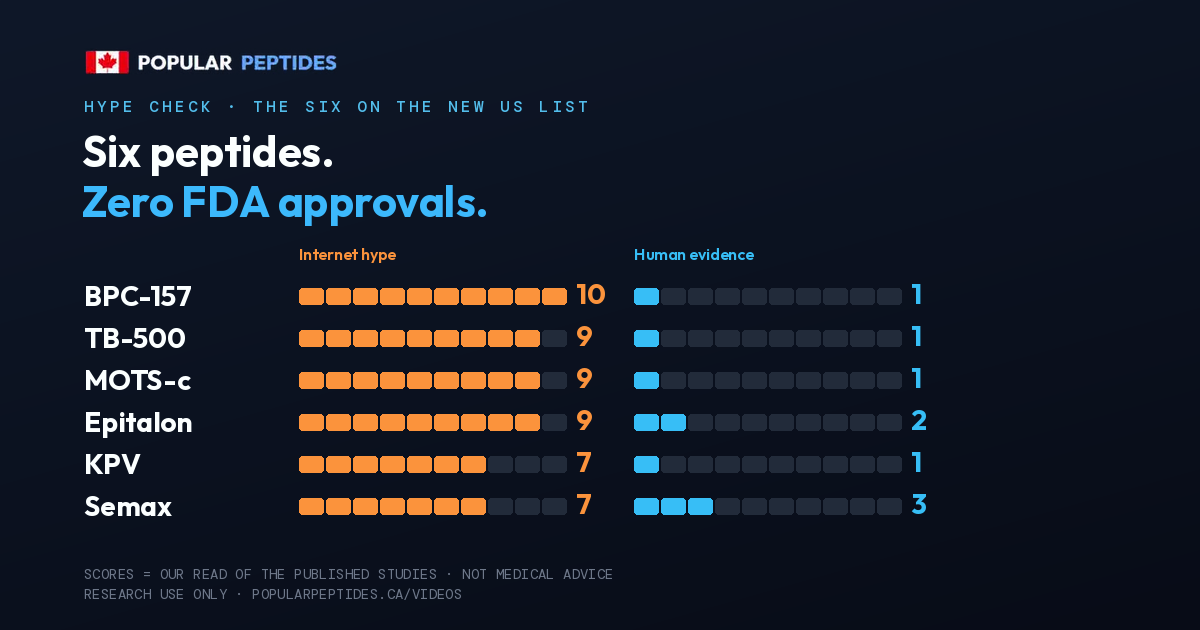
Free to share this chart: please link back to this page.
| Peptide | Hype | Human evidence |
|---|---|---|
| BPC-157 | 10/10 | 1/10 |
| TB-500 | 9/10 | 1/10 |
| MOTS-c | 9/10 | 1/10 |
| Epitalon | 9/10 | 2/10 |
| KPV | 7/10 | 1/10 |
| Semax | 7/10 | 3/10 |
BPC-157
The most hyped of the six, and the one with the widest gap. The rodent literature is large; the human literature is a handful of small reports. We went through it study by study in the BPC-157 hype check and in what BPC-157 can't promise.
TB-500
The name TB-500 is used for two things: a short synthetic piece of thymosin beta-4 (the Ac-LKKTETQ fragment), and, by many suppliers including us, synthetic full-length thymosin beta-4. The full protein has reached human trials: an eye-drop version, RGN-259, was tested for dry eye in a 317-patient phase 2/3 trial that did not meet its primary endpoints (2016), though some secondary measures improved. No published human trial has tested TB-500 itself. WADA lists thymosin-β4 and its derivatives, TB-500 included, as prohibited in sport. More on how it compares with BPC-157: BPC-157 vs TB-500.
MOTS-c
A mitochondria-derived peptide with striking results in mice, nicknamed "exercise in a bottle". No published human trial has shown the effects seen in mice. Full breakdown: the MOTS-c hype check.
Epitalon
Epitalon (Ala-Glu-Asp-Gly) is a four-amino-acid peptide modelled on a pineal gland extract first studied in Russia. The telomere claim does come from real papers:
- —Cells: Khavinson and colleagues reported telomerase activity and telomere elongation in human fibroblasts (*Bulletin of Experimental Biology and Medicine*, 2003).
- —An independent 2025 study (Al-dulaimi et al., *Biogerontology*) also saw telomeres lengthen in normal cells, and in breast cancer cell lines too, through a separate pathway called ALT.
- —Mice: Anisimov et al. (*Biogerontology*, 2003) found no change in average lifespan; maximum lifespan rose 12.3%.
- —Humans: a few small studies in elderly people, mostly from one research group and often using the older pineal extract rather than the synthetic peptide. No large independent randomised trial.
KPV
KPV (Lys-Pro-Val) is the last three amino acids of alpha-MSH. In mouse models of colitis it reduced inflammation (Kannengiesser et al., *Inflammatory Bowel Diseases*, 2008). There are no published human trials. More: KPV inflammation research.
Semax
The best-documented of the six: Semax is a licensed medicine in Russia, with a long Russian-language literature. Independent trials outside Russia are scarce, which is why it still scores 3/10. We covered it with its sister peptide in the Semax & Selank hype check.
What it means in Canada
Nothing changes. This is a US enforcement policy for US pharmacies and physicians. It does not apply in Canada, and it does not make any of these six an approved drug anywhere.
In April 2026, Health Canada published an advisory, "Think twice before injecting peptides bought online", that named 14 peptides. Five of these six are on it: BPC-157, Epitalon, KPV, MOTS-c and TB-500 (Semax is not). The advisory also says a "research use only" label does not make a product legal to sell for human use.
The pattern
Read the scores again: six peptides, and the best human-evidence score is 3/10. A policy about who may compound something is not evidence that it works. When a clip says "approved", ask: approved by whom, for what, and based on which trial?
Read the studies, not the headlines.
Did the FDA approve BPC-157 and the other five peptides?
No. The October 28, 2026 policy is enforcement discretion for certain compounding pharmacies and physicians in the United States. HHS states it is not FDA approval and does not establish safety or effectiveness.
Which six peptides are in the US policy?
BPC-157, Epitalon, KPV, MOTS-c, Semax and TB-500.
Does the US policy change anything in Canada?
No. It is a US policy and does not apply in Canada. Health Canada's April 2026 advisory still names BPC-157, Epitalon, KPV, MOTS-c and TB-500.
---
Popular Peptides supplies research compounds for in vitro laboratory research use only. They are not approved by Health Canada for therapeutic use and are not intended for human or veterinary consumption. 18+. Certificates of Analysis (COAs) are for members only.
We source from distributors whose batches are third-party tested for HPLC purity and measured content. Certificates of Analysis (COAs) are for members only.