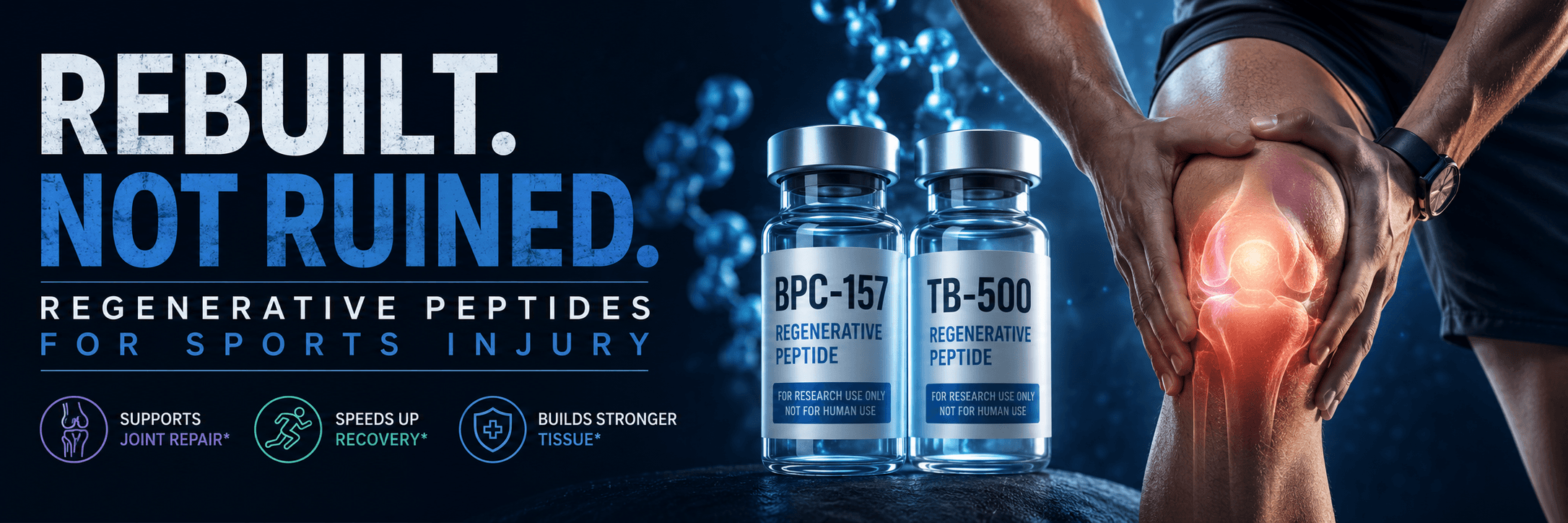
Regenerative Peptides and Tissue-Repair Research: BPC-157, TB-500, and GHK-Cu
An overview of the peptides most often studied in tissue-repair and connective-tissue research — BPC-157, TB-500, and GHK-Cu — and the preclinical mechanisms behind the interest.
- Tissue-repair peptide research centres on BPC-157, TB-500, and GHK-Cu, studied in preclinical models — this overview is informational and does not describe or endorse any human use.
- BPC-157 is a synthetic 15-amino-acid peptide derived from a gastric protein, studied in tissue-repair, gut-lining, tendon, ligament, muscle, and nerve models.
- TB-500, a Thymosin Beta-4 fragment, is studied for actin regulation, cell migration, and angiogenesis; it and BPC-157 are often studied together for their complementary mechanisms.
- GHK-Cu is a copper-binding tripeptide studied for collagen and glycosaminoglycan synthesis, metalloproteinase activity, and angiogenesis in skin and connective-tissue models.
- When sourcing these, prioritise third-party testing, COAs, batch transparency, purity standards, and secure domestic shipping. Research use only.
A Closer Look at Tissue-Repair Peptide Research
Few areas of peptide science have attracted as much attention as tissue repair. Chronic connective-tissue issues are a long-standing research problem, and several peptides have become focal points for laboratories studying the cellular mechanisms behind repair, remodelling, and recovery.
This article provides a neutral overview of the compounds most often discussed in that literature. It is informational only and does not describe or endorse any use in humans.
What Are Regenerative Peptides?
Regenerative peptides are short chains of amino acids studied for their potential role in tissue repair and cellular signalling within research models.
Investigators have examined a range of peptides for their possible relevance to repair processes involving muscle, tendon, ligament, and connective-tissue models. Research in this area remains preclinical and ongoing.
Some of the peptides most commonly referenced in regenerative research include:
Many of these compounds are sold strictly for laboratory research purposes and are not approved therapeutic treatments in Canada.
BPC-157
BPC-157 (Body Protection Compound 157) is a synthetic 15-amino-acid peptide derived from a protein found in gastric juice. In preclinical models it has been studied for its potential role in tissue repair, gut-lining integrity, and the response of tendon, ligament, muscle, and nerve tissue.
The breadth of preclinical literature is one reason BPC-157 is so frequently referenced in tissue-repair research discussions.
TB-500 (Thymosin Beta-4)
TB-500 is a synthetic fragment related to Thymosin Beta-4, a peptide present in many cell types. Research has focused on its role in actin regulation, cell migration, and angiogenesis — processes central to how tissue models reorganise during repair.
In the literature, BPC-157 and TB-500 are often studied together because their proposed mechanisms are complementary.
GHK-Cu
GHK-Cu is a naturally occurring copper-binding tripeptide that has been extensively studied for its effects on collagen and glycosaminoglycan synthesis, metalloproteinase activity, and angiogenesis in skin and connective-tissue models. It is one of the most-cited peptides in the cosmetic and wound-healing research literature.
Why Interest in This Research Continues to Grow
Interest in tissue-repair peptide research has expanded alongside the broader growth of the peptide field. Several factors contribute:
- —**Expanding literature**: New preclinical studies continue to examine how these peptides interact with repair and remodelling pathways.
- —**Mechanistic clarity**: Researchers increasingly understand the receptor and signalling pathways involved.
- —**Documentation standards**: As the field matures, purity verification and batch documentation have become baseline expectations.
Choosing a Research Peptide Supplier in Canada
For laboratories sourcing these compounds, quality and documentation should come first. When evaluating a supplier, consider:
- —Third-party testing
- —Certificates of Analysis (COAs)
- —Batch transparency
- —Product purity standards
- —Secure shipping within Canada
- —Responsive customer support
Reliable sourcing is essential for maintaining confidence in research-grade material.
Final Thoughts
BPC-157, TB-500, and GHK-Cu sit at the centre of one of the most active areas of peptide research. The preclinical literature is substantial, and interest among researchers continues to grow as mechanisms become better characterised.
For laboratories studying tissue repair, the priority is the same as in any rigorous research program: well-documented, third-party-verified material and a clear understanding of what the published science does — and does not — yet establish.
**Disclaimer**: Research peptides are intended for laboratory and research purposes only. Compounds discussed in this article are not approved by Health Canada for the diagnosis, treatment, cure, or prevention of any disease, and are not intended for human or veterinary use.
Sourcing these compounds in Canada
Compounds referenced in this guide:
- —**BPC-157**
- —**TB-500 (Thymosin Beta-4)**
- —**GHK-Cu**
These are supplied for laboratory research use and ship from within Canada — Vancouver, BC, typically 2 to 5 business days, tracked and insured. Published-batch HPLC purity averages above 99%, verified by a third-party lab, and every certificate is searchable by lot number. No customs risk, no USD conversion, free shipping over $300 CAD.
Browse every published lab result before you order, or check the reference library for molecular data on each compound.
Frequently asked questions
Which compounds are studied in tissue repair models?
BPC-157 and TB-500 are the two most frequently studied, and are combined in the Wolverine.
Are these approved for treating injuries?
No. They are supplied for in vitro laboratory research use only and are not approved by Health Canada for therapeutic use in humans or animals.
What purity should I expect?
Greater than 99%, HPLC and LC-MS verified by an independent lab, with a certificate retrievable by lot number.
Every batch we sell is independently third-party tested, with the full Certificate of Analysis published and checkable by lot number.