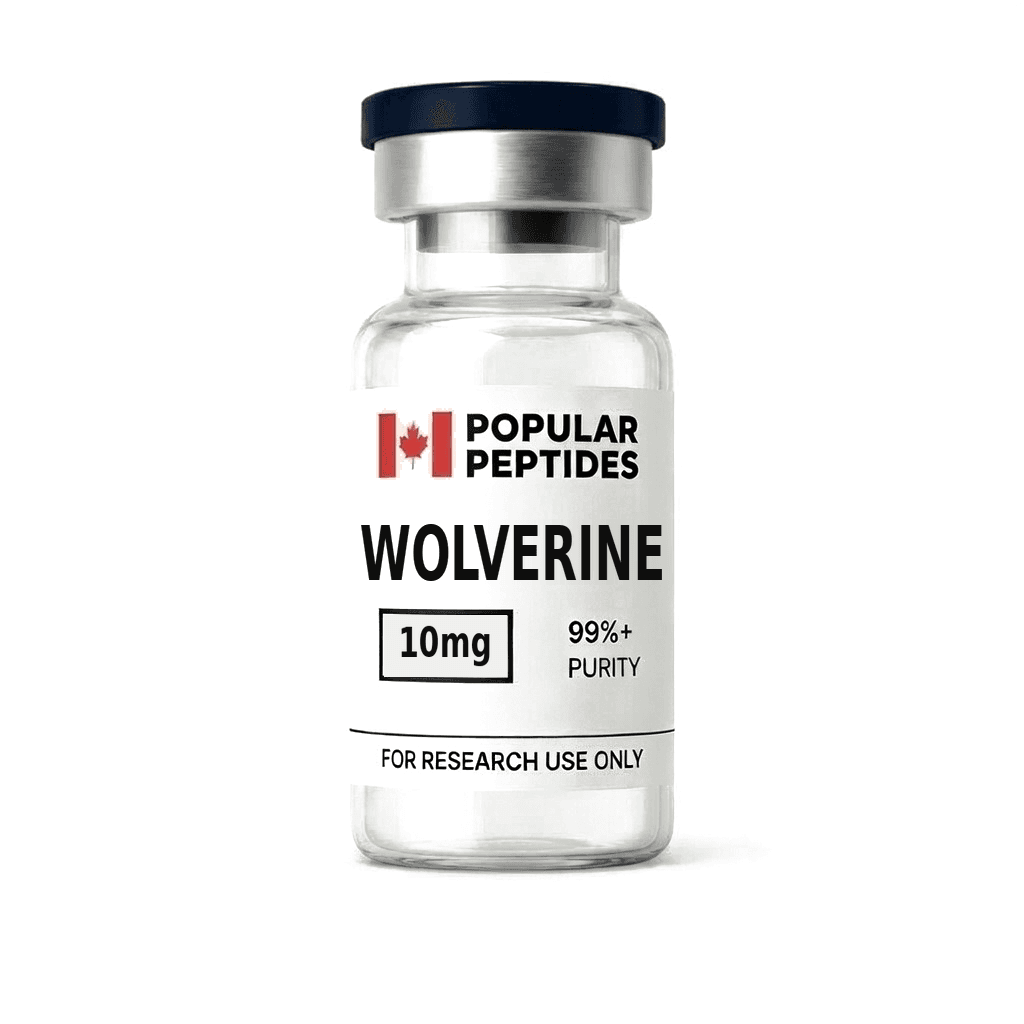
Wolverine (BPC-157 + TB-500)10mg research bundle · Canada
Buy 2 and save $11.60 — 10% off every unit
- Ships from Vancouver — no customs, no duties
- Dispatched in 1–2 business days · tracked & insured
Add $242.01 more for free shipping
Key facts
- Compound:
- Wolverine (BPC-157 + TB-500)
- Purity:
- ≥99%, verified by HPLC
- Tested by:
- independent third-party lab (HPLC purity and measured content)
- Certificate of analysis:
- available on request · members-only lab results
- Ships from:
- Vancouver, BC — typically 2–5 business days, tracked and insured, no customs
- Intended use:
- in vitro laboratory research only — not for human or veterinary consumption
Page last updated
Wolverine is a single 10 mg vial holding BPC-157 (5 mg) and TB-500 (5 mg), the two peptides most often studied together for tissue repair, blended in one preparation.
Wolverine (BPC-157 + TB-500) for tissue-repair research, shipped Canada-wide from Vancouver. One 10 mg vial, ≥99% purity. Tested by an independent lab for purity and content (HPLC), and the lab report (COA) for your batch is available on request. Tracked, insured delivery across Canada — by Canada Post Xpresspost, usually 1 to 4 business days, with no customs step and no brokerage fee.
Sold as a laboratory research material only, for in vitro use. It isn’t a medicine and isn’t meant for people or animals.
Primary literature
- The promoting effect of pentadecapeptide BPC 157 on tendon healing involves tendon outgrowth, cell survival, and cell migration — Journal of Applied Physiology, 2011
Preclinical tendon-healing work — outgrowth, cell survival and migration in rat models.
- Thymosin beta4 activates integrin-linked kinase and promotes cardiac cell migration, survival and cardiac repair — Nature, 2004
Bock-Marquette et al. Established the actin-binding mechanism (ILK/Akt activation) that underpins most later thymosin beta-4 work.
- Thymosin beta4 accelerates wound healing — Journal of Investigative Dermatology, 1999
Malinda et al. Full-thickness rat and mouse wound models; accelerated keratinocyte migration and collagen deposition.
Cited for research context. A citation is not a claim that this compound is safe, effective, or approved for any use.
Research Use Only. This compound is a laboratory material for in vitro research. It is not a medicine and is not for human or veterinary use. If you’re looking for help with your health, please speak with a doctor or pharmacist.
New to research compounds? Start here. Buying in Canada: why domestic means no customs. Checking quality: how to read a COA.
What is Wolverine? Wolverine at a glance
In short: Wolverine is $57.99 CAD at Popular Peptides Canada, ships from Vancouver with no customs, and usually arrives in 1–4 business days.
- What it is
- Wolverine is a single 10 mg vial holding BPC-157 (5 mg) and TB-500 (5 mg), the two peptides most often studied together for tissue repair, blended in one preparation.
- Price
- $57.99 CAD. Prices are in Canadian dollars, so there’s no exchange-rate surprise.
- Size
- 10mg
- Purity
- ≥99%, tested by an independent lab (HPLC purity and content)
- Ships from
- Vancouver, BC, to anywhere in Canada. It never crosses a border, so there’s no customs and no brokerage fee.
- Delivery
- Dispatched in 1–2 business days by Canada Post Xpresspost, tracked and insured. Usually 1–2 days in BC, 2–3 on the Prairies and to major Ontario and Québec cities, 2–4 in Atlantic Canada.
- Shipping cost
- Free over $300 CAD, otherwise a flat $20.
- Lab report
- Available on request. Lab results are kept in our members-only area.
- Pay with
- Visa, Mastercard, Apple Pay, Google Pay or Interac e-Transfer (an extra 10% off by e-Transfer).
- Sold for
- Laboratory research only. It isn’t a medicine and isn’t meant for people or animals.
New to this? Our plain-language guide explains everything from lab reports to delivery, and our Canada vs imported guide shows why ordering inside Canada is simpler.
Wolverine — compound background
Two-component repair blend — BPC-157 (5 mg) + TB-500 (5 mg) in one 10 mg vial
Wolverine combines the two most-studied tissue-repair peptides in a single 10 mg vial: BPC-157 (5 mg) and TB-500 (5 mg). It inherits the handling profile of both — the forgiving, gastric-derived BPC-157 and the oxidation-sensitive Thymosin-Beta-4 fragment TB-500 — so the blend is handled to the stricter of the two.
Solubility & reconstitution
Both components are freely water-soluble and dissolve together in plain bacteriostatic water without acidification. Add diluent gently, since TB-500 is a light powder that can scatter.
Commonly reconstituted so the combined solids sit around 5 mg/mL.
Storage
Sealed powder stable at -20 °C. Refrigerate at 2-8 °C and protect from light, because the TB-500 component is oxidation-sensitive.
Commonly worked with for 2-4 weeks at 2-8 °C — governed by the shorter-lived TB-500 component.
Stability
BPC-157 is one of the most forgiving peptides in the catalogue, but the blend is only as robust as its TB-500 component, so treat the whole vial with TB-500-level light discipline.
Reading the Certificate of Analysis
A blend COA should show both components — two principal peaks on RP-HPLC and both target masses on LC-MS (about 1419.5 Da for BPC-157 and 4963.5 Da for TB-500) — and ideally the ratio between them. Scan just above the TB-500 mass for a +16 Da oxidation companion.
Background and handling information is educational, for in-vitro laboratory research use only — not medical advice, dosing, or usage guidance, and not a description of use in humans or animals.
How much does Wolverine (BPC-157 + TB-500) cost in Canada?+
Where can I buy Wolverine (BPC-157 + TB-500) in Canada?+
What sizes of Wolverine (BPC-157 + TB-500) are available?+
Is Wolverine (BPC-157 + TB-500) third-party tested?+
What purity is Wolverine (BPC-157 + TB-500)?+
Is Wolverine (BPC-157 + TB-500) intended for human or veterinary use?+
Do you ship Wolverine (BPC-157 + TB-500) across Canada?+
How should Wolverine (BPC-157 + TB-500) be stored?+
Wolverine laboratory reference
Wolverine (BPC-157 + TB-500) is two-component repair blend — bpc-157 (5 mg) + tb-500 (5 mg) in one 10 mg vial. Handling requirements follow from that chemistry rather than from generic peptide guidance — the pages below cover each aspect specifically for this compound.
Lyophilized and reconstituted storage conditions, plus the practical working window.
Diluent selection, dissolution behaviour, and the calculator preset for this compound.
Which solvents work, why, and what abnormal dissolution behaviour indicates.
The specific chemical routes by which this molecule breaks down, and how to limit each.
Which assays are informative for this molecule, and what to actually check on its COA.
Compound-specific bench practices, and the errors most often made with this molecule.
What to inspect on arrival, and which conditions actually warrant rejecting a vial.
Questions specific to this compound — structure, chemistry, and common misconceptions.
Wolverine compared with
Reference content is educational laboratory-handling information for in-vitro research use only — not medical advice, not usage guidance, and not a protocol.