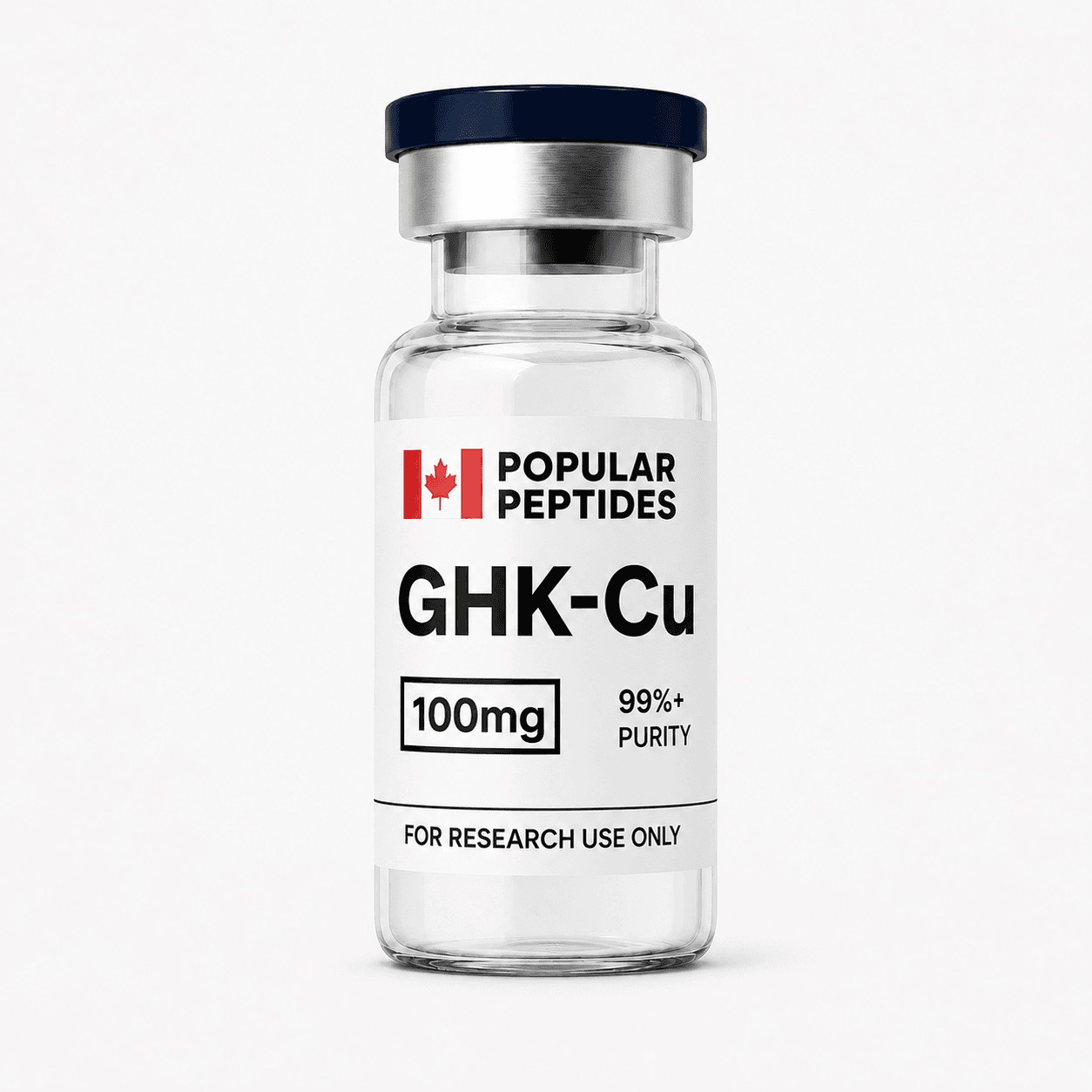
GHK-Cu100mg research peptide · Canada
Buy 2 and save $12.00 — 10% off every unit
- Ships from Vancouver — no customs, no duties
- Dispatched in 1–2 business days · tracked & insured
Add $240.01 more for free shipping
Key facts
- Compound:
- GHK-Cu
- Purity:
- ≥99%, verified by HPLC
- Tested by:
- independent third-party lab (HPLC purity and measured content)
- Molecular weight:
- 340.38 g/mol
- Certificate of analysis:
- available on request · members-only lab results
- Ships from:
- Vancouver, BC — typically 2–5 business days, tracked and insured, no customs
- Intended use:
- in vitro laboratory research only — not for human or veterinary consumption
Page last updated
GHK-Cu is a tiny peptide, just three amino acids, bonded to copper, which is why it turns blue when mixed. It occurs naturally in the body and is one of the most studied peptides in skin and tissue research. Keep it away from light. It comes as a freeze-dried powder in 100 mg vials.
Buy GHK-Cu in Canada direct from Popular Peptides. Available in 100 mg, ≥99% purity, molecular weight 340.38 g/mol. Tested by an independent lab for purity and content (HPLC), and the lab report (COA) for your batch is available on request. Tracked, insured delivery from Vancouver, BC — by Canada Post Xpresspost, usually 1 to 4 business days, with no customs step and no brokerage fee.
Sold as a laboratory research material only, for in vitro use. It isn’t a medicine and isn’t meant for people or animals.
Primary literature
- Skin Regenerative and Anti-Cancer Actions of Copper Peptides — Cosmetics, 2018
Pickart & Margolina on GHK-Cu as a gene modulator; reports GHK altering expression of a large fraction of human genes.
Cited for research context. A citation is not a claim that this compound is safe, effective, or approved for any use.
Research Use Only. This compound is a laboratory material for in vitro research. It is not a medicine and is not for human or veterinary use. If you’re looking for help with your health, please speak with a doctor or pharmacist.
New to research compounds? Start here. Buying in Canada: why domestic means no customs. Checking quality: how to read a COA.
What is GHK-Cu? GHK-Cu at a glance
In short: GHK-Cu is $59.99 CAD at Popular Peptides Canada, ships from Vancouver with no customs, and usually arrives in 1–4 business days.
- What it is
- GHK-Cu is a tiny peptide, just three amino acids, bonded to copper, which is why it turns blue when mixed. It occurs naturally in the body and is one of the most studied peptides in skin and tissue research.
- Price
- $59.99 CAD. Prices are in Canadian dollars, so there’s no exchange-rate surprise.
- Size
- 100mg
- Purity
- ≥99%, tested by an independent lab (HPLC purity and content)
- Ships from
- Vancouver, BC, to anywhere in Canada. It never crosses a border, so there’s no customs and no brokerage fee.
- Delivery
- Dispatched in 1–2 business days by Canada Post Xpresspost, tracked and insured. Usually 1–2 days in BC, 2–3 on the Prairies and to major Ontario and Québec cities, 2–4 in Atlantic Canada.
- Shipping cost
- Free over $300 CAD, otherwise a flat $20.
- Lab report
- Available on request. Lab results are kept in our members-only area.
- Pay with
- Visa, Mastercard, Apple Pay, Google Pay or Interac e-Transfer (an extra 10% off by e-Transfer).
- Sold for
- Laboratory research only. It isn’t a medicine and isn’t meant for people or animals.
New to this? Our plain-language guide explains everything from lab reports to delivery, and our Canada vs imported guide shows why ordering inside Canada is simpler.
GHK-Cu — compound background
Tripeptide-copper(II) complex (Gly-His-Lys : Cu²⁺)
GHK was identified by Loren Pickart in 1973 as a factor in human plasma whose concentration declines markedly with age. The decisive later finding was that its activity depends on chelated copper(II) — the peptide and the metal function as a unit. GHK-Cu is therefore a coordination complex, not simply a peptide, and it is the only such compound in this catalogue.
Solubility & reconstitution
Freely water-soluble, and unmistakable: GHK-Cu solutions are a distinct blue. That colour is the copper(II) coordination itself, which makes this the one compound here whose integrity you can partly assess by eye. A properly reconstituted vial gives a clear, evenly blue solution.
Storage
Sealed at -20 °C, dry and dark. The dry complex is stable; moisture is the main enemy. Refrigerate at 2–8 °C, protected from light. Solution pH matters unusually much here: the copper-histidine coordination weakens as pH falls, and the complex can dissociate in acidic conditions.
Commonly worked with for 2–4 weeks at 2–8 °C.
Stability
For GHK-Cu, colour is data. A solution that has gone pale, colourless, or green rather than clear blue is signalling that the coordination chemistry has changed, and no peptide-based intuition covers that.
Reading the Certificate of Analysis
Peptide purity alone is insufficient for a coordination complex. The informative figure is copper content — ideally by ICP-MS or atomic absorption — confirming the intended peptide-to-copper stoichiometry. A COA reporting only HPLC purity describes the ligand while saying nothing about whether the metal is present in the right proportion.
Background and handling information is educational, for in-vitro laboratory research use only — not medical advice, dosing, or usage guidance, and not a description of use in humans or animals.
How much does GHK-Cu cost in Canada?+
Where can I buy GHK-Cu in Canada?+
What sizes of GHK-Cu are available?+
Is GHK-Cu third-party tested?+
What purity is GHK-Cu?+
Is GHK-Cu intended for human or veterinary use?+
Do you ship GHK-Cu across Canada?+
How should GHK-Cu be stored?+
GHK-Cu laboratory reference
GHK-Cu is tripeptide-copper(ii) complex (gly-his-lys : cu²⁺). Handling requirements follow from that chemistry rather than from generic peptide guidance — the pages below cover each aspect specifically for this compound.
Lyophilized and reconstituted storage conditions, plus the practical working window.
Diluent selection, dissolution behaviour, and the calculator preset for this compound.
Which solvents work, why, and what abnormal dissolution behaviour indicates.
The specific chemical routes by which this molecule breaks down, and how to limit each.
Which assays are informative for this molecule, and what to actually check on its COA.
Compound-specific bench practices, and the errors most often made with this molecule.
What to inspect on arrival, and which conditions actually warrant rejecting a vial.
Questions specific to this compound — structure, chemistry, and common misconceptions.
GHK-Cu compared with
Reference content is educational laboratory-handling information for in-vitro research use only — not medical advice, not usage guidance, and not a protocol.