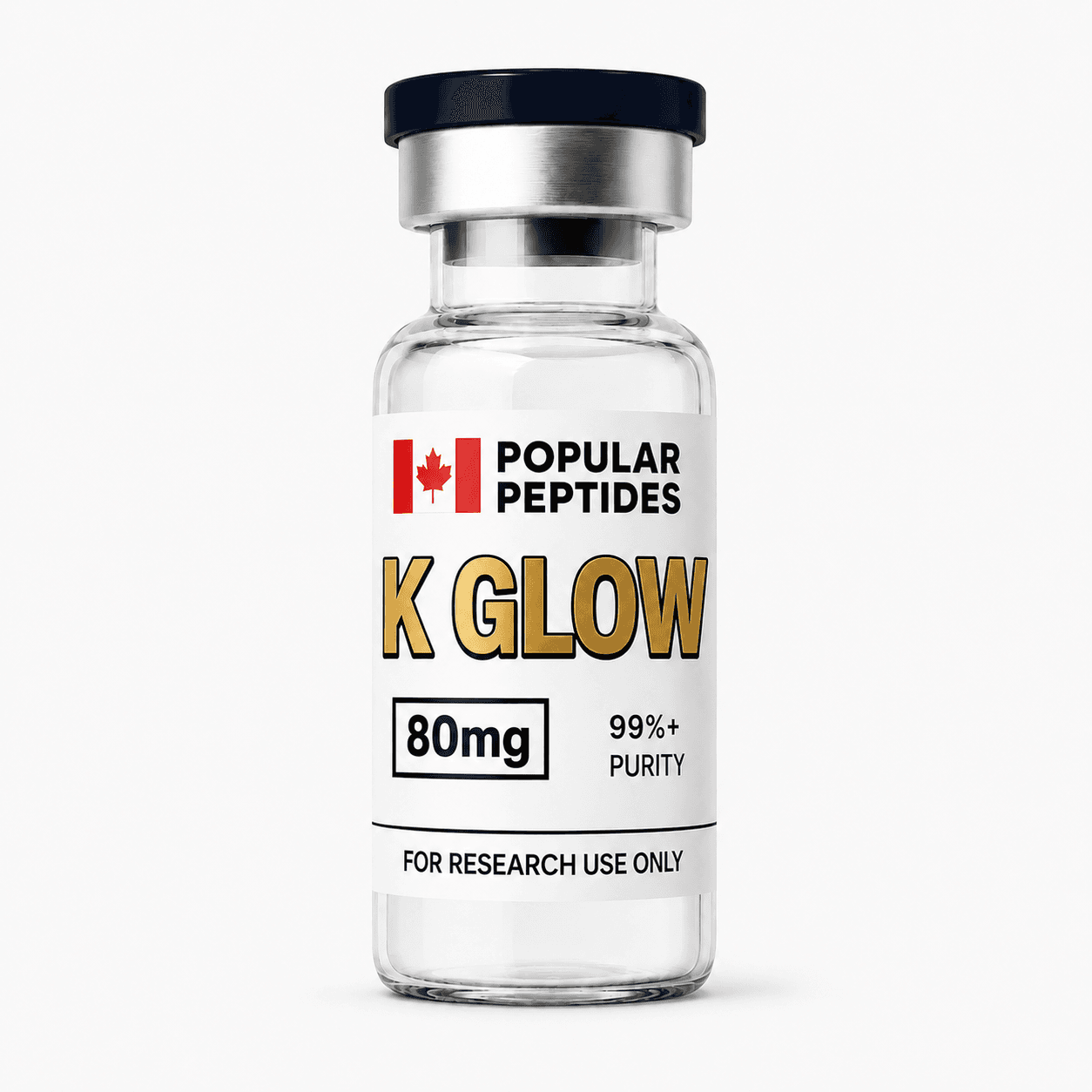
KGLOW80mg research peptide · Canada
Also written and searched as KLOW — same compound, same vial, same lot number.
Buy 2 and save $25.00 — 10% off every unit
- Ships from Vancouver — no customs, no duties
- Dispatched in 1–2 business days · tracked & insured
Add $175.01 more for free shipping
Key facts
- Compound:
- KGLOW
- Also known as:
- KLOW
- Purity:
- ≥98%, verified by HPLC
- Tested by:
- independent third-party lab (HPLC purity and measured content)
- Certificate of analysis:
- available on request · members-only lab results
- Ships from:
- Vancouver, BC — typically 2–5 business days, tracked and insured, no customs
- Intended use:
- in vitro laboratory research only — not for human or veterinary consumption
Page last updated
KGLOW (also spelled KLOW) is four popular peptides blended into one vial, so you don’t need to buy them separately. One 80 mg vial contains GHK-Cu (50 mg), BPC-157 (10 mg), TB-500 (10 mg) and KPV (10 mg). As a majority copper-peptide preparation it develops a blue colour, must not contact acidic liquid or a chelating agent, and is best kept in the dark.
KGLOW, supplied to Canadian researchers by Popular Peptides. One 80 mg vial, ≥98% purity. Tested by an independent lab for purity and content (HPLC); the lab report (COA) for your batch is available on request. Ships tracked and insured from Vancouver by Canada Post Xpresspost, usually 1 to 4 business days, with no customs step and no brokerage fee.
Sold as a laboratory research material only, for in vitro use. It isn’t a medicine and isn’t meant for people or animals.
Primary literature
- Skin Regenerative and Anti-Cancer Actions of Copper Peptides — Cosmetics, 2018
Covers GHK-Cu, the majority component of this blend.
- The promoting effect of pentadecapeptide BPC 157 on tendon healing involves tendon outgrowth, cell survival, and cell migration — Journal of Applied Physiology, 2011
Covers the BPC-157 component.
- Thymosin beta4 activates integrin-linked kinase and promotes cardiac cell migration, survival and cardiac repair — Nature, 2004
Bock-Marquette et al. Established the actin-binding mechanism (ILK/Akt activation) that underpins most later thymosin beta-4 work.
- Thymosin beta4 accelerates wound healing — Journal of Investigative Dermatology, 1999
Malinda et al. Full-thickness rat and mouse wound models; accelerated keratinocyte migration and collagen deposition.
- PepT1-mediated tripeptide KPV uptake reduces intestinal inflammation — Gastroenterology, 2008
Dalmasso et al. Studied KPV uptake through the PepT1 transporter in intestinal cells in vitro and in mouse colitis models.
- Melanocortin-derived tripeptide KPV has anti-inflammatory potential in murine models of inflammatory bowel disease — Inflammatory Bowel Diseases, 2008
Kannengiesser et al. Examined KPV in mouse models of colitis.
Cited for research context. A citation is not a claim that this compound is safe, effective, or approved for any use.
Research Use Only. This compound is a laboratory material for in vitro research. It is not a medicine and is not for human or veterinary use. If you’re looking for help with your health, please speak with a doctor or pharmacist.
New to research compounds? Start here. Buying in Canada: why domestic means no customs. Checking quality: how to read a COA.
What is KGLOW? KGLOW at a glance
In short: KGLOW is $124.99 CAD at Popular Peptides Canada, ships from Vancouver with no customs, and usually arrives in 1–4 business days.
- What it is
- KGLOW (also spelled KLOW) is four popular peptides blended into one vial, so you don’t need to buy them separately. One 80 mg vial contains GHK-Cu (50 mg), BPC-157 (10 mg), TB-500 (10 mg) and KPV (10 mg).
- Price
- $124.99 CAD. Prices are in Canadian dollars, so there’s no exchange-rate surprise.
- Size
- 80mg
- Purity
- ≥98%, tested by an independent lab (HPLC purity and content)
- Ships from
- Vancouver, BC, to anywhere in Canada. It never crosses a border, so there’s no customs and no brokerage fee.
- Delivery
- Dispatched in 1–2 business days by Canada Post Xpresspost, tracked and insured. Usually 1–2 days in BC, 2–3 on the Prairies and to major Ontario and Québec cities, 2–4 in Atlantic Canada.
- Shipping cost
- Free over $300 CAD, otherwise a flat $20.
- Lab report
- Available on request. Lab results are kept in our members-only area.
- Pay with
- Visa, Mastercard, Apple Pay, Google Pay or Interac e-Transfer (an extra 10% off by e-Transfer).
- Sold for
- Laboratory research only. It isn’t a medicine and isn’t meant for people or animals.
New to this? Our plain-language guide explains everything from lab reports to delivery, and our Canada vs imported guide shows why ordering inside Canada is simpler.
KGLOW — compound background
Four-component dermal research blend — GHK-Cu 50 mg / BPC-157 10 mg / TB-500 10 mg / KPV 10 mg (80 mg total)
KGLOW is GLOW with a fourth component added: KPV, a tripeptide (Lys-Pro-Val) corresponding to the C-terminal fragment of alpha-melanocyte-stimulating hormone. The other three amounts are unchanged — GHK-Cu 50 mg, BPC-157 10 mg, TB-500 10 mg — with KPV at 10 mg bringing the vial to 80 mg. KPV is studied primarily for anti-inflammatory activity in preclinical models, notably retaining that property of the parent hormone without its pigmentation-related effects.
Solubility & reconstitution
All four components are freely water-soluble and reconstitute together. As with GLOW the solution is blue, since GHK-Cu is still the majority component at 62.5% by mass. KPV is very small and highly water-soluble, adding no dissolution difficulty. The same pH constraint applies: never use acidic diluent, because it dissociates copper from the GHK-Cu component.
An 80 mg vial in 3 mL gives roughly 27 mg/mL combined (≈16.7 mg/mL GHK-Cu, 3.3 mg/mL each of the other three).
Storage
Sealed at -20 °C, dry and dark. Refrigerate at 2–8 °C, protected from light — driven by the TB-500 methionine and the photo-reactive GHK-Cu copper complex.
Commonly worked with for 2–3 weeks at 2–8 °C, set by the TB-500 and GHK-Cu components.
Stability
Adding KPV does not change the handling profile. GHK-Cu still dominates and still dictates the rules: neutral pH, no chelators, light protection.
Reading the Certificate of Analysis
A meaningful KGLOW COA resolves all four components with a stated ratio approximating 50:10:10:10 by mass. Copper content should be confirmed separately for the GHK-Cu component. KPV is small and elutes early on RP-HPLC, so confirm the method actually resolves it rather than losing it near the solvent front.
Background and handling information is educational, for in-vitro laboratory research use only — not medical advice, dosing, or usage guidance, and not a description of use in humans or animals.
How much does KGLOW cost in Canada?+
Where can I buy KGLOW in Canada?+
What sizes of KGLOW are available?+
Is KGLOW third-party tested?+
What purity is KGLOW?+
Is KGLOW intended for human or veterinary use?+
Do you ship KGLOW across Canada?+
How should KGLOW be stored?+
KGLOW laboratory reference
KGLOW is four-component dermal research blend — ghk-cu 50 mg / bpc-157 10 mg / tb-500 10 mg / kpv 10 mg (80 mg total). Handling requirements follow from that chemistry rather than from generic peptide guidance — the pages below cover each aspect specifically for this compound.
Lyophilized and reconstituted storage conditions, plus the practical working window.
Diluent selection, dissolution behaviour, and the calculator preset for this compound.
Which solvents work, why, and what abnormal dissolution behaviour indicates.
The specific chemical routes by which this molecule breaks down, and how to limit each.
Which assays are informative for this molecule, and what to actually check on its COA.
Compound-specific bench practices, and the errors most often made with this molecule.
What to inspect on arrival, and which conditions actually warrant rejecting a vial.
Questions specific to this compound — structure, chemistry, and common misconceptions.
KGLOW compared with
Reference content is educational laboratory-handling information for in-vitro research use only — not medical advice, not usage guidance, and not a protocol.